Bedtime stories in your own voice work because children are not only listening to the words. They are listening for familiarity, safety, and the feeling that someone who knows them is close. A parent voice, grandparent voice, or trusted caregiver voice can make a bedtime story feel more personal than even the most polished narrator.
That is why "in your own voice" bedtime story apps are becoming a serious search category.
Parents want the emotional warmth of reading aloud, but real nights are messy. Work runs late. A parent travels. One child needs help while another is already waiting in bed. A family may want a grandparent's voice in the routine. Some parents simply run out of energy before they run out of bedtime requests.
Voice-cloning story apps promise a solution: record your voice once, then let the app create or narrate a fresh story that sounds like you.
That can be useful.
It also raises questions about privacy, consent, safety, and whether bedtime is becoming more automated than connected.
This guide explains when parent-voice bedtime stories help, what to check before using voice cloning, and how to use a personalized story tool like Lulawe when you want the story to sound like home.
Quick Answer: Best Way To Use Your Voice at Bedtime
The safest and most emotionally useful workflow is simple:
- Create or choose one calm story before the final wind-down.
- Use your own voice live when you are available.
- Use a private recording or trusted voice app only when it genuinely helps the routine.
- Keep the child off the screen at lights-out.
- End with the same short goodnight phrase every night.
A bedtime story in your own voice should reduce friction, not replace the relationship.
If you are home, read the story yourself.
If you are away, tired, or trying to preserve a familiar routine, a recorded or generated parent voice can be a useful bridge.
Why Children Respond to a Familiar Voice
Children often settle better when a bedtime routine feels predictable. The room, order of events, story tone, and adult voice all become cues that the day is ending.
That is why a familiar voice can matter so much.
The American Academy of Pediatrics has long encouraged families to read aloud with children. HealthyChildren.org, the AAP's parent-facing site, recommends reading to children every day and describes read-aloud time as a shared parent-child moment, not just a literacy exercise.
The voice is part of that experience.
A professional narrator may sound beautiful, but a parent voice carries context:
- the way you slow down near the end
- the phrase you always repeat
- the gentle correction when the child interrupts
- the familiar rhythm of your bedtime routine
- the emotional signal that the child is not alone
For bedtime, that can be more valuable than production quality.
What "In Your Own Voice" Means
There are 3 practical versions of bedtime stories in your own voice.
| Format | How it works | Best use |
|---|---|---|
| Live read-aloud | Parent reads the story at bedtime | Best for connection and younger children |
| Parent recording | Parent records a story once and replays it | Good for travel, shared custody, or grandparent stories |
| AI voice narration | App creates narration from an adult voice sample | Useful when families want fresh personalized audio without recording every night |
The right option depends on the job.
If your child needs closeness, live reading wins.
If your child needs consistency when you cannot be there, a recording or private voice model may help.
If your child needs fresh stories but your energy is low, a personalized story tool can create the story and let your voice carry it.
Current Voice-Story App Pattern
Current voice-first bedtime story products usually promise 4 things:
| Promise | What parents should verify |
|---|---|
| Record once | How much audio is required, and who is allowed to record |
| Child is the hero | Whether personalization uses only safe, minimal details |
| Narrated in your voice | Whether the voice model is private, deletable, and consent-based |
| Screen-free bedtime | Whether the child can listen without tapping, watching, or browsing |
Recent examples in this space include NinniTales, TaleTuck, Mama's Voice, StoryFox, and similar "parent voice" story apps.
They are not all the same product, but the category is clear: parents want personalized bedtime stories that sound like a trusted adult.
That is a high-intent search. It is not just "give me a story." It is "give my child a story that feels like us."
Where Lulawe Fits
Lulawe is useful when the hardest part is creating the story, not cloning the voice.
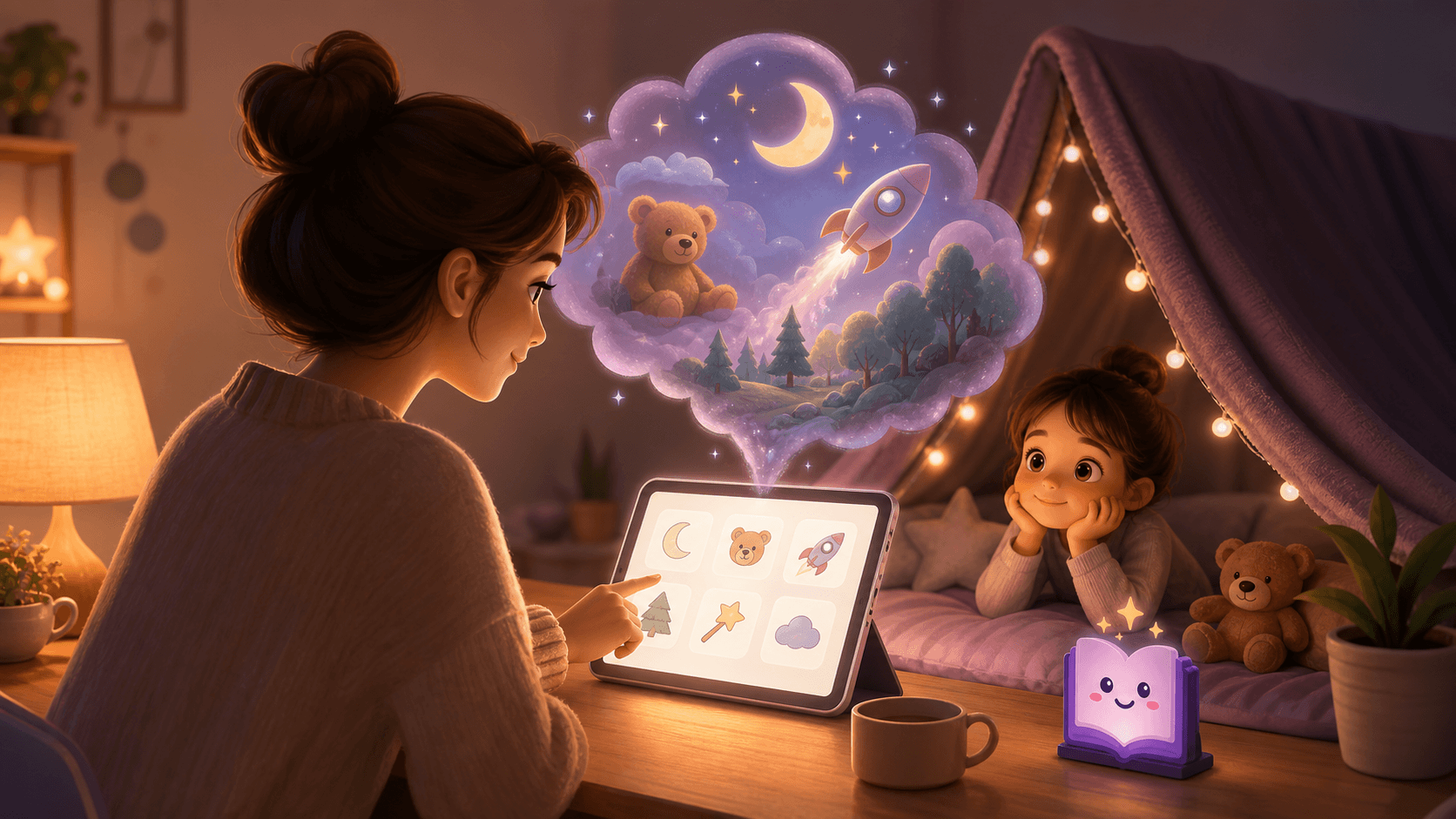
The parent can use Lulawe to create a personalized bedtime story around:
- the child's age
- a first name or nickname
- one or two interests
- a familiar memory
- a gentle bedtime goal
- a calm ending
Then the parent reads it aloud in their own voice.
That distinction is important. Lulawe should not be positioned as a voice-cloning app if the family specifically needs automatic narration in a cloned parent voice. But it is a strong fit for parents who want the warmth of their own voice with better story material than they can invent at 8:30pm.
In other words:
| Parent need | Best fit |
|---|---|
| "I want my cloned voice to narrate automatically" | Voice-cloning bedtime story app |
| "I want a better personalized story to read myself" | Lulawe |
| "I want a story I can record for tomorrow" | Lulawe plus a simple recording app |
| "I want no screen at bedtime" | Create story earlier, then read or play audio later |
| "I want a family keepsake" | Parent-read or parent-recorded personalized story |
That is the honest conversion angle.
Lulawe helps create the story that your voice can make feel real.
Voice-Cloning Bedtime Stories: When They Help
A parent-voice app can be genuinely useful in specific situations.
When a parent travels
A child who is used to a parent reading each night may miss the sound more than the plot. A recorded or generated voice story can keep one part of the routine stable.
Keep it simple:
- one story
- low volume
- no browsing
- same closing phrase
- another adult nearby if the child needs reassurance
When grandparents are part of the routine
Some families want a grandparent's voice in bedtime, especially across distance. A short recorded story can become a keepsake and a connection point.
Use adult consent clearly. Do not record or clone anyone's voice without permission.
When parents are exhausted
Sometimes the goal is not a magical tech experience. The goal is getting through bedtime kindly.
If an app creates one calm story in a familiar voice and stops there, it can reduce stress.
If it creates 15 minutes of setup, upgrades, settings, and arguments, it is not helping.
When a child needs repetition
Some children ask for the same voice, same phrase, or same story every night. A parent-recorded version can preserve that pattern when the adult cannot read live.
For more on repetition, see Toddler Wants the Same Story Every Night.
When Live Reading Is Better
Do not use automation just because it exists.
Live reading is usually better when:
- the parent is available
- the child is anxious
- the child needs touch, eye contact, or real-time reassurance
- the child is under 5 and wants closeness more than variety
- the story may need to change based on the child's mood
- the app would add screen use near bedtime
Common Sense Media's 2026 AI chatbot guidance warns that young children need real human connection and that AI should not become a substitute for parents in moments of comfort. A bedtime story app should support the adult-child routine, not stand in as an emotional companion.
That is the core boundary.
Use technology to make the story easier.
Do not use it to hand over the relationship.
Privacy Checklist for Parent-Voice Story Apps
Voice is sensitive data. Treat it more carefully than a normal account preference.
Before recording your voice into any bedtime story app, check:
| Question | Strong answer |
|---|---|
| Whose voice can be recorded? | Adults only, with consent |
| Can the voice model be deleted? | Yes, clearly from settings |
| Is voice data encrypted? | Yes, in transit and at rest |
| Is the voice used outside story narration? | No |
| Is the voice shared with third parties? | No, or clearly limited |
| Does the app collect a child's voice? | Ideally no |
| Can children create open prompts? | No, parent-controlled |
| Are there ads at bedtime? | No |
| Can the app work screen-free? | Yes |
The Federal Trade Commission has warned that AI voice cloning can be misused for fraud and scams, and has separately published work on reducing risks from voice-cloning technologies. That does not mean every parent-voice app is unsafe. It means families should treat voice data as something worth protecting.
If an app's privacy policy is vague, skip it.
Child Safety Checklist
A parent voice can make a story feel safer, but voice alone does not make content safe.
Check the story itself:
- Is the language age-appropriate?
- Is the conflict small and resolved?
- Does the ending feel complete?
- Are there no scary scenes or cliffhangers?
- Is the story short enough for bedtime?
- Does it avoid sensitive personal details?
- Can the parent review it before the child hears it?
For AI-generated stories, use the same standards explained in Are AI Bedtime Stories Safe for Kids?.
A familiar voice can make a bad story more convincing. That is why parent review matters.
What To Put in a Parent-Voice Bedtime Story
Use a small amount of personalization.
Good details:
- first name or nickname
- age
- favorite topic
- one familiar place, described generally
- one bedtime goal
- one safe object, such as a blanket or night light
Avoid:
- full name
- school name
- address
- exact birthday
- medical details
- private family conflict
- anything you would not want stored by an app
Personalization should make the story feel warm, not expose the child.
A Lulawe Workflow for Stories in Your Own Voice
Use this when you want the story to sound like you without needing a voice-cloning product.
1. Create the story earlier
Use Lulawe before the final wind-down window, not when your child is already overtired.
Add only a few inputs:
- age
- one interest
- one mood
- one bedtime goal
Example:
A calm bedtime story for a 5-year-old who loves space, feels nervous in the dark, and needs a peaceful ending.
2. Review the story
Read it quickly before sharing.
Trim anything too exciting. If the ending is not sleepy enough, regenerate or edit the final paragraph.
3. Read it in your own voice
Use your normal bedtime rhythm. Slow down during the last third. Lower your volume near the end.
The goal is not performance.
The goal is safety.
4. Record it only if useful
If you will be away tomorrow, record the story on your phone after reading it once.
Keep the recording private. Store it where your child cannot start an endless playlist.
5. End with the same phrase
Example:
Story is done. You are safe. I love you. It is sleep time.
Repeated phrasing can become a sleep association. The child learns that the familiar voice and familiar ending mean the same thing every night.
Parent Voice vs Professional Narration
Professional narration has advantages. It can be polished, steady, and easy to play.
But parent voice has a different advantage: emotional specificity.
| Feature | Parent voice | Professional narrator |
|---|---|---|
| Familiarity | Very high | Low to medium |
| Production quality | Varies | Usually high |
| Emotional connection | Strong | Depends on child |
| Consistency when parent is away | Good if recorded or cloned | Good |
| Personal bedtime phrases | Easy | Usually absent |
| Best use | Connection, reassurance, family routine | Low-effort listening, older children, audio libraries |
This is why many families use both.
A professional audio bedtime story can be helpful on ordinary nights. A parent-voice story can be especially helpful when the child needs closeness.
Screen-Free Setup
The biggest practical mistake is handing the voice-story app to the child at lights-out.
Do not do that.
Use this setup instead:
- Parent creates or chooses the story.
- Parent starts playback or reads aloud.
- Device stays face-down, dimmed, or out of reach.
- Child listens without browsing.
- Story ends once.
For a full pattern, see Screen-Free Bedtime Story App: Parent Guide.
The screen-free part matters because bedtime audio should narrow attention. It should not open another menu.
Best Age Fit
| Age | Best voice-story format | Why |
|---|---|---|
| 1-2 | Live parent reading | Voice, touch, and repetition matter most |
| 3-4 | Short parent-read personalized story | Familiar details help transitions |
| 5-6 | Parent-read or recorded story | Children can follow a simple custom plot |
| 7-8 | Audio or parent-read story | Listening stamina improves |
| 9-10 | Audio, chapter, or recorded family story | Older children can use stories more independently |
For very young children, keep the technology nearly invisible.
The adult voice and routine are the point.
What To Avoid
Avoid parent-voice story setups that include:
- public voice sharing
- unclear voice deletion
- child voice collection
- open child chat
- autoplay
- feeds or recommendations
- rewards for more listening
- dramatic music at lights-out
- long setup during bedtime
- story themes that create fear or suspense
If the tool makes bedtime longer, it has failed the bedtime test.
The 3-Night Bedtime Test
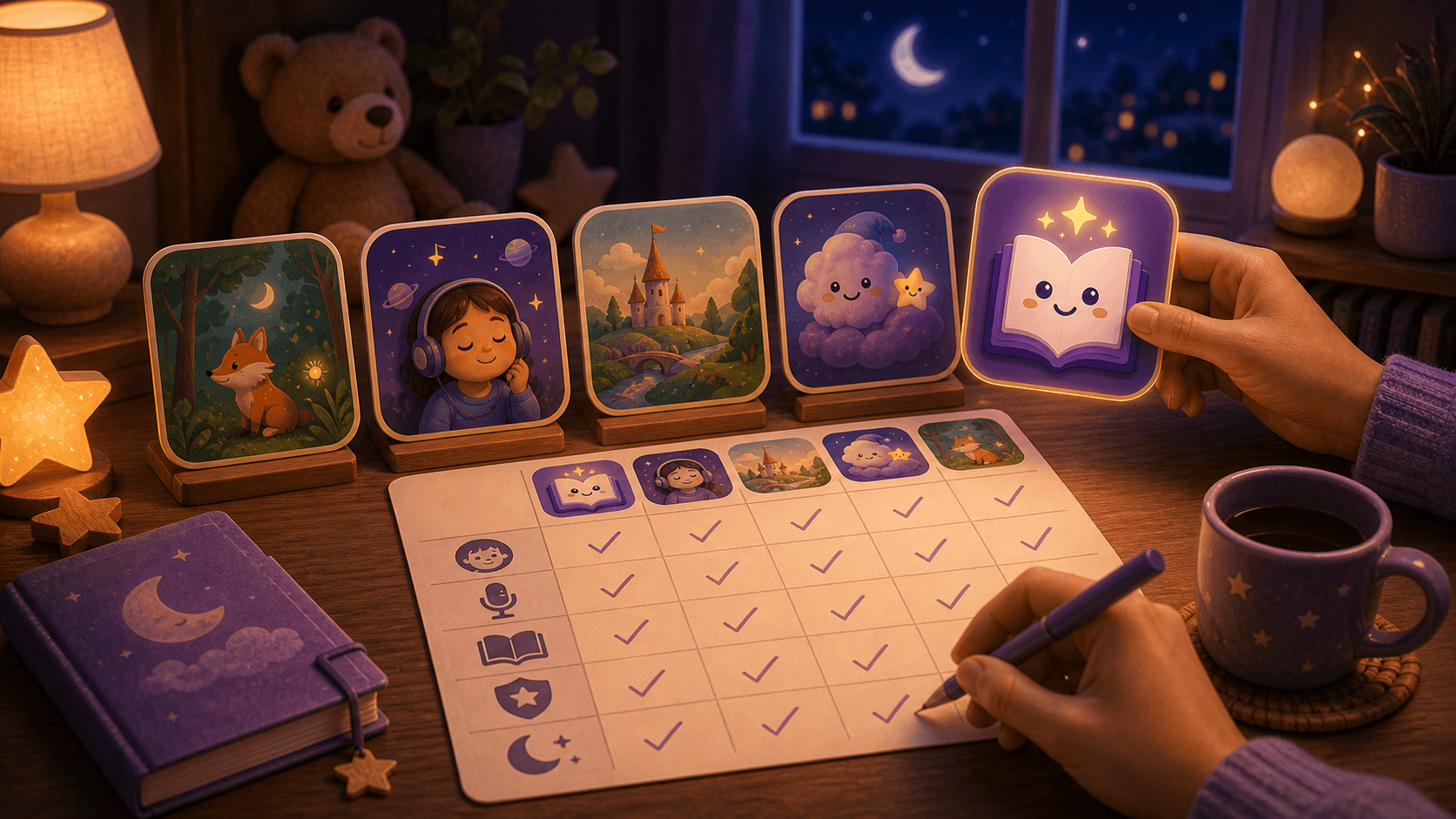
Before relying on any voice-story app, test it for 3 nights.
| Question | Night 1 | Night 2 | Night 3 |
|---|---|---|---|
| Was the story ready before bedtime? | Yes / No | Yes / No | Yes / No |
| Did the child stay off the screen? | Yes / No | Yes / No | Yes / No |
| Did the story end clearly? | Yes / No | Yes / No | Yes / No |
| Was bedtime calmer? | Yes / No | Yes / No | Yes / No |
| Did parent effort go down? | Yes / No | Yes / No | Yes / No |
Keep the tool only if it improves at least 3 of those 5 rows.
Otherwise, use a simpler read-aloud routine.
Sources Used
- HealthyChildren.org: Tips to Help Your Child Enjoy Reading Aloud
- AAP policy statement on literacy promotion
- Common Sense Media: AI Chatbots and Your Child
- Common Sense Media: AI in the Toy Box
- FTC: Approaches to Address AI-enabled Voice Cloning
- FTC Consumer Advice: Scammers use AI to enhance family emergency schemes
Try a Personalized Story in Your Own Voice
Lulawe helps parents create personalized bedtime stories around a child's age, interests, memories, and bedtime goal. Create one calm story before lights-out, then read it in the voice your child already knows best: yours.
Final Takeaway
Bedtime stories in your own voice are powerful because they combine story, routine, and relationship.
Voice-cloning apps can help when distance, travel, or exhaustion gets in the way. But the safest pattern is still parent-led: choose one calm story, protect voice data, keep the screen away, and use the familiar voice as a bridge to sleep.
If you want fresh story ideas without losing the warmth of reading aloud, create the story with Lulawe, then let your own voice do the most important part.