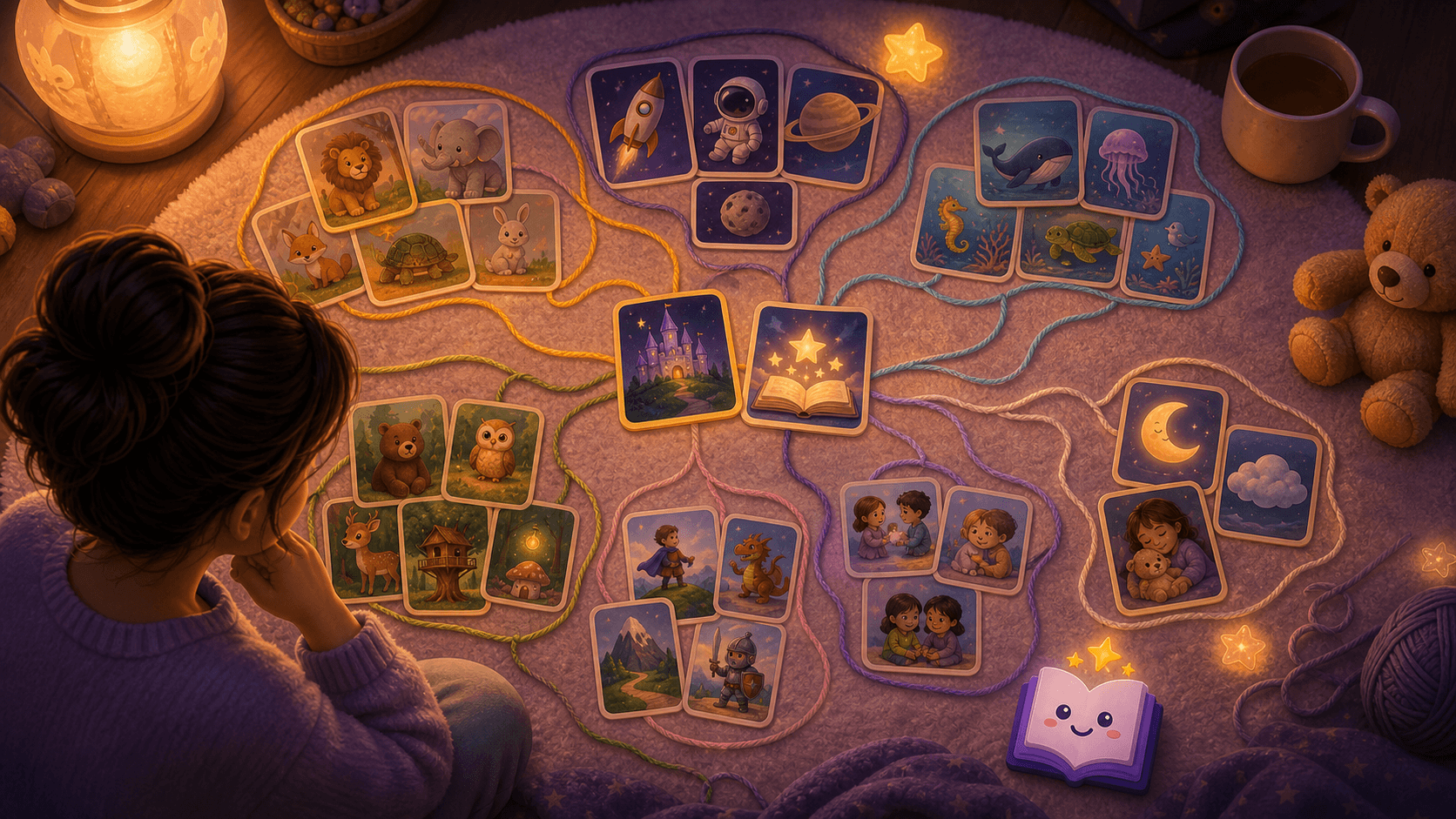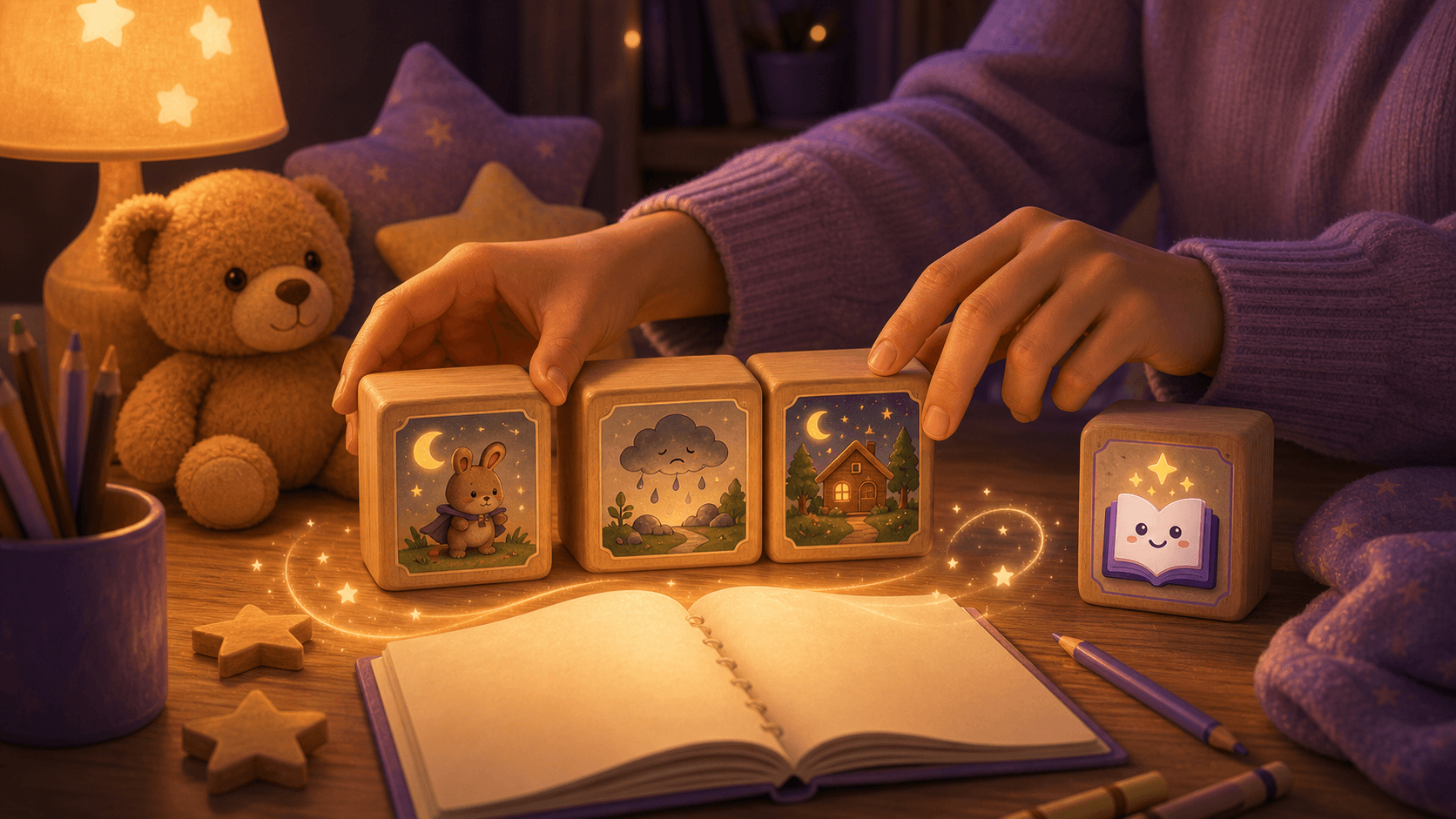
If your toddler wants the same story every night, it is usually a sign of comfort, learning, and predictability, not a problem you need to fix. Keep the favorite story, then add tiny variations when you want freshness: one new voice, one new question, one changed detail, or a personalized version with the same calm ending.
Parents often worry that repetition means their child is bored, stuck, or not building imagination. Toddlers usually experience it differently. The same story gives them control at a time of day when they are tired, dependent, and getting ready to separate for sleep.
The real challenge is not whether repetition is good or bad. It is how to protect the comfort your child gets from the repeated story without making bedtime miserable for the adult reading it.
Key Takeaways
- Repeating the same bedtime story is normal for toddlers and preschoolers.
- Familiar plots reduce bedtime friction because the child knows what comes next.
- Repetition can support word learning, especially when the story is read warmly and consistently.
- You do not need to force variety; use small changes instead.
- Personalized bedtime stories work best when they keep a familiar structure and change one meaningful detail.
Why Toddlers Want the Same Story Every Night
Toddlers live in a world where many things feel new, surprising, or outside their control. A repeated bedtime story does the opposite. It is known. It has the same beginning, the same middle, and the same ending.
That predictability matters at bedtime.
By the end of the day, a toddler may be tired but still alert enough to resist transitions. A familiar story lowers the number of new things they have to process. They already know the characters. They know the scary part is not truly scary. They know the parent will turn the same pages, say the same line, and arrive at the same safe ending.
Scholastic summarizes the parent-facing version well: children often love repetition because it gives them a sense of control and anticipation. They enjoy knowing what comes next and feeling the satisfaction of being right.
In other words, the repeated story is not only entertainment. It is part of the bedtime routine.
Repetition Can Help Learning
There is a practical learning reason toddlers ask for repeats: the first reading is often not enough.
In a new story, your child is doing several things at once:
- learning who the characters are
- following the plot
- matching words to pictures
- tracking emotions
- noticing rhyme, rhythm, and repeated phrases
- trying to predict the ending
On the second, third, or tenth reading, the plot demands less effort. That frees attention for details.
A Frontiers in Psychology study on preschool word learning found strong effects for both repeated story reading and sleep after story exposure. Children who heard the same story repeatedly learned more words than children who heard different stories in that study setup, and sleep also helped consolidate learning.
That does not mean a toddler should hear only one book forever. It means repetition is doing real work. A favorite bedtime book can become a stable language environment where new words, patterns, and emotional cues become easier to absorb.
The CDC also gives a simple developmental recommendation for toddlers: read to them daily. The daily habit matters more than making every night novel.
Same Story vs New Story: What Is Better?
For bedtime, the best answer is usually not either-or.
Use the favorite story as the anchor, then add variety around it.
| Parent goal | Better choice |
|---|---|
| Child is tired and close to sleep | Read the same favorite story |
| Parent wants language variety | Add one short new book before the favorite |
| Child is anxious or clingy | Keep the familiar ending |
| Parent is bored | Change voice, pacing, or one question |
| Child asks for "again" endlessly | Set a clear repeat limit before starting |
| Child wants a story about themselves | Use a personalized version with the same calm shape |
A new story can build vocabulary, imagination, and flexibility. A repeated story can build security, confidence, participation, and a strong sleep cue.
The best routine gives your child both over time.
Try the Two-Book Rule
If your toddler refuses every new book, try a simple rule:
One parent pick, one child pick.
Your pick should be short, calm, and easy to finish. Their pick can be the repeated favorite.
For example:
- Parent reads a two-minute new story.
- Toddler gets the familiar favorite.
- The routine ends the same way every night.
This protects the emotional value of the favorite story while giving you a small opening for variety.
Do not introduce the new book as a replacement. That makes it feel like a threat. Introduce it as a tiny bonus before the guaranteed favorite.
How to Make the Same Story Feel Fresh
You can refresh the repeated story without changing the book.
Try one tiny variation per night:
- Let your toddler finish one repeated phrase.
- Ask one simple "what happens next?" question.
- Whisper one page and read the next page normally.
- Count one recurring object in the illustrations.
- Use a different voice for one familiar character.
- Point out one color, shape, animal, or emotion.
- Connect one scene to your child's day.
Keep the change small. Too many questions can make bedtime more alert and less restful.
The goal is not to turn reading into a lesson. The goal is to help the adult stay engaged while the child keeps the security of the familiar story.
When Repetition Becomes a Bedtime Delay
Sometimes "read it again" means comfort. Sometimes it means delay.
You can usually tell by the pattern.
Comfort sounds like:
- "Same book."
- "Again."
- joining in with repeated lines
- relaxing as the story begins
- accepting the ending after one or two readings
Delay sounds like:
- asking to restart on the last page
- changing the rules after you agree
- demanding another book after the favorite
- becoming more animated with every repeat
- arguing after the limit was clear
If it has become a delay tactic, do not debate the story. Set the limit before you begin:
"We will read this one time tonight. You can say the sleepy line with me. Then the book goes beside your pillow."
For some toddlers, a visual cue helps. Put one bookmark on the bed. When the bookmark goes into the book, storytime is finished.
Use Personalization as a Bridge, Not a Bribe
This is where a personalized bedtime story can help.
Many parents try to solve repetition with novelty: a totally new story, a new book pile, or an AI-generated adventure every night. That can work for some children, but it can also make bedtime feel more stimulating.
A better approach is familiar structure plus one personal twist.
For example, if your toddler loves the same bear book, keep the bear-book shape:
| Familiar element | Personalized variation |
|---|---|
| Bear looks for a blanket | Your child helps Bear find a blue blanket |
| Bear says goodnight to the forest | Your child says goodnight to three favorite animals |
| Bear gets worried in the dark | Your child shows Bear the night light |
| Bear falls asleep in a den | Your child tucks Bear into a cozy cave |
The child gets what they want: predictability.
The parent gets what they need: a little freshness.
Lulawe is built around that kind of parent-led personalization. You can keep the story calm, familiar, and age-aware while changing the hero, interest, setting, or bedtime goal. If that fits your routine, join the Lulawe waitlist.
A Same-Story Variation Formula
Use this five-line formula when your toddler wants the same story but you need something slightly new:
Tonight, [child name] and [favorite character] went back to [familiar place].
This time, they found [one small new object].
The object needed help with [gentle problem].
They solved it by [kind, simple action].
Then everyone returned to the same cozy ending: [familiar goodnight phrase].
Example:
Tonight, Nora and Little Bear went back to the moon garden. This time, they found a sleepy silver button beside the path. The button belonged to the moon's pajama pocket, and it needed help getting home. Nora and Little Bear followed three quiet stars, sewed the button back in place, and whispered, "Soft night, safe night, see you in the morning."
This is not a brand-new universe. It is a gentle remix of a known one.
What Not to Do
Avoid turning repetition into a fight.
Do not say:
- "You are too old for this book."
- "This book is boring."
- "We are never reading this again."
- "You need to choose something new."
- "Only babies read the same story."
Those responses can accidentally make the favorite book feel even more emotionally important.
Instead, name the comfort and set the boundary:
"You really love this story. We can read it one time tonight, and tomorrow I will choose one short story first."
That keeps the relationship warm while giving the routine structure.
When to Ask for Extra Support
Wanting the same story is usually normal. It is one small behavior inside a much bigger picture.
Consider asking a pediatrician, speech-language professional, or qualified child development professional for guidance if repetition is paired with broader concerns, such as loss of language skills, very limited communication, intense distress over small changes in many settings, or other development questions that worry you.
The story preference alone is rarely the issue. Look at the whole child.
Sources
- Frontiers in Psychology: Goodnight book: sleep consolidation improves word learning via storybooks
- CDC: Positive Parenting Tips for Toddlers
- Scholastic: Read It Again!
- Raising Children Network: Reading and storytelling with babies and children
Bottom Line
If your toddler wants the same story every night, keep the story.
The repeat may be helping them feel safe, learn language, join in, and move toward sleep with less resistance. When you need variety, add it gently: one parent-picked book, one small question, one changed detail, or a personalized bedtime story with the same calm ending.
For toddlers, the familiar story is not a rut. It is often the bridge from a busy day to a quiet night.