Children love personalized bedtime stories because the story feels like it belongs to them. Hearing their name, favorite animal, real memory, or everyday worry inside a gentle story makes the child feel seen. That personal relevance can hold attention better than a generic plot and can make bedtime feel more connected, predictable, and emotionally safe.
A personalized story does not need to be complicated.
It can be as simple as:
- "Mia and the sleepy moon boat"
- "Noah and the blanket fort"
- "Ava learns that the dark is just the room resting"
- "Theo and the tiny train that whispered goodnight"
The magic is not that the story is technically custom.
The magic is that the child recognizes themselves inside it.
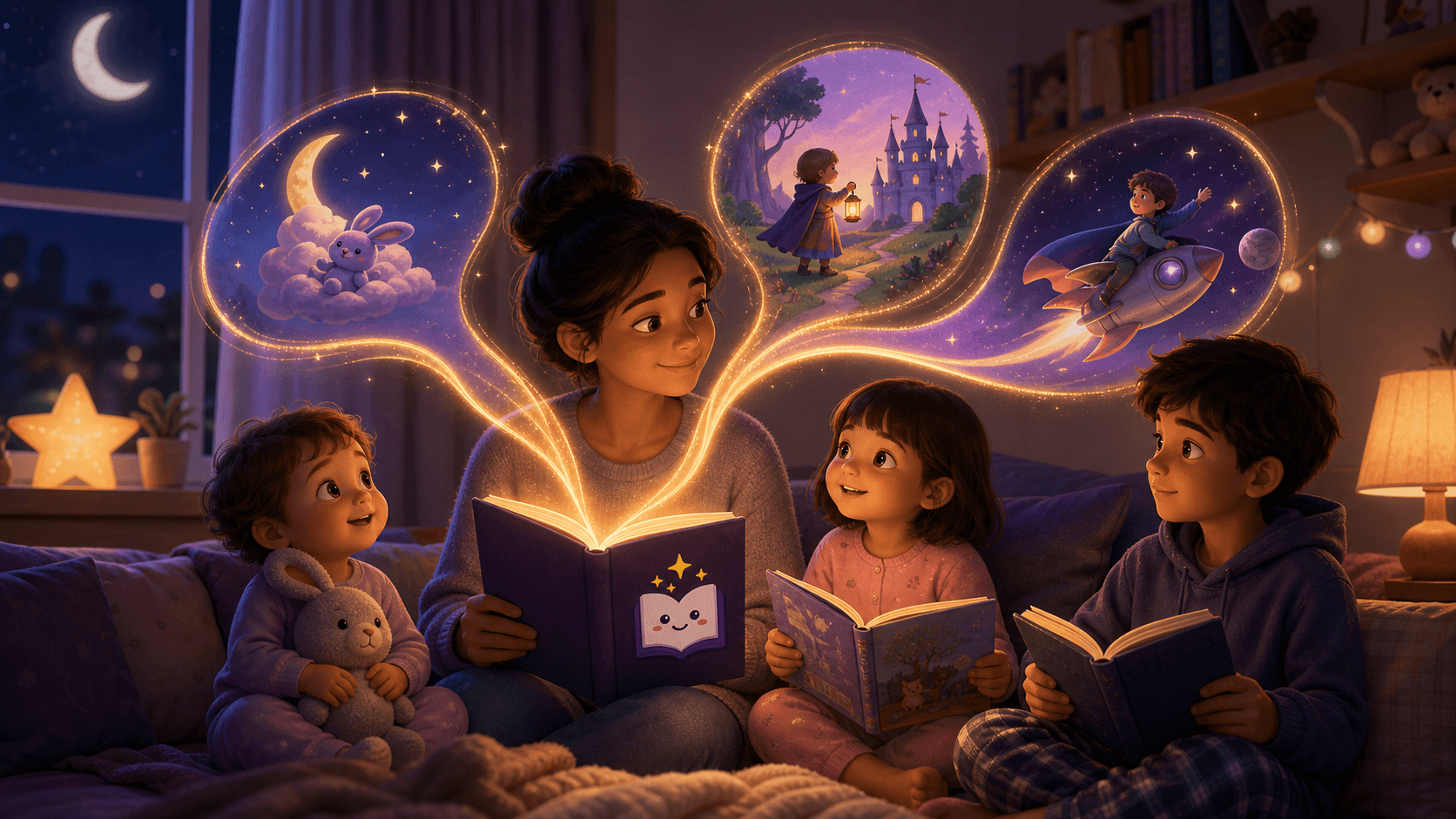
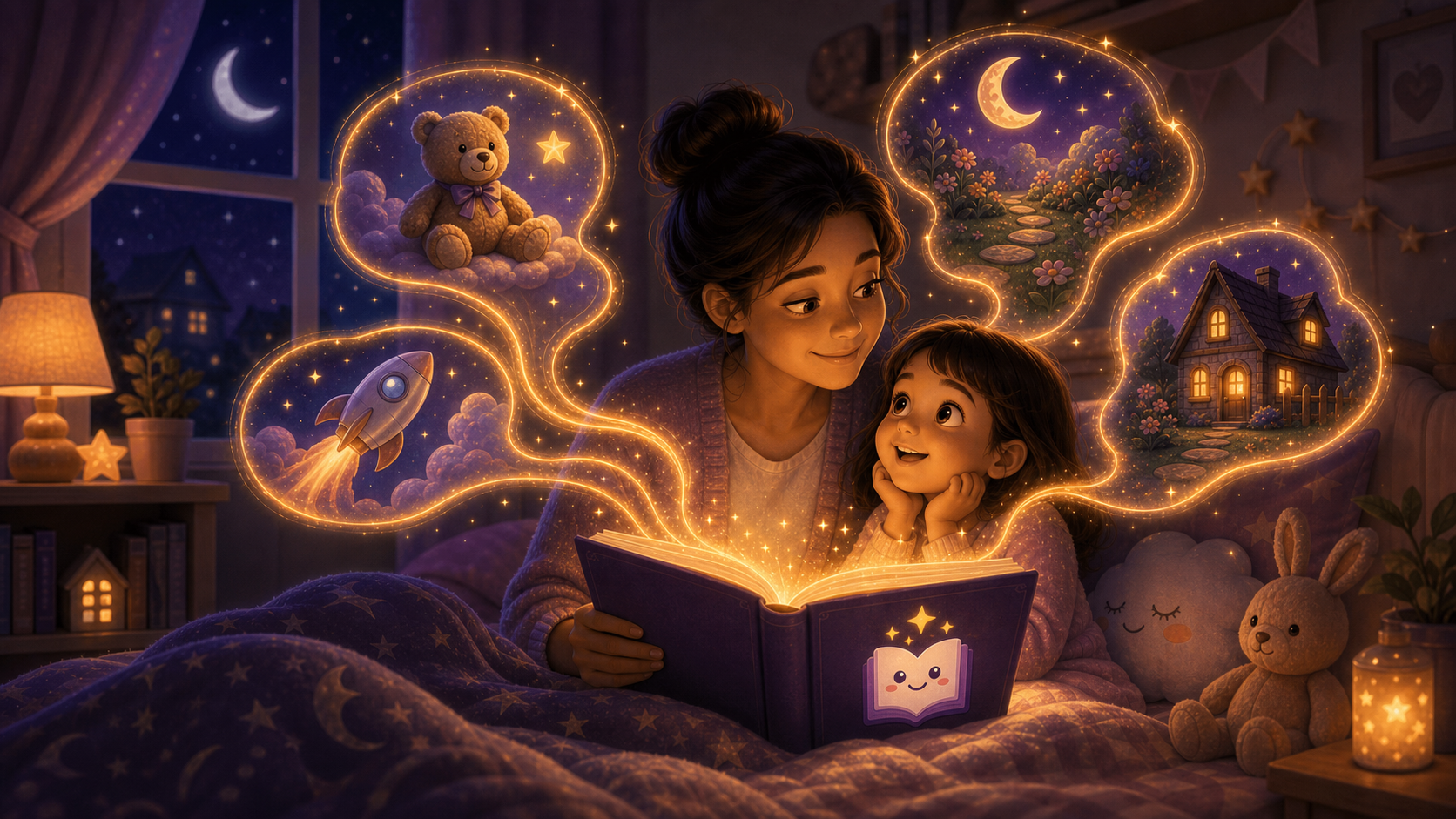
That is why personalized bedtime stories can be so powerful at night. They combine imagination with familiarity. A child can travel to the moon, meet a talking cloud, or explore a pillow castle while still feeling anchored by their own name, favorite things, and the parent's voice.
Quick Answer: Why Do Kids Love Personalized Stories?
Kids love personalized stories for 5 main reasons:
- Their name makes the story feel immediately relevant.
- Familiar details help the story feel safe and easy to follow.
- Being the main character gives children a sense of agency.
- Personal stories invite more parent-child conversation.
- A gentle custom ending can match the child's bedtime mood.
This is also why personalized stories often work well for tired parents. The parent does not have to invent an entire new world from scratch. One real detail from the child's day can become the beginning of tonight's story.
A Child's Name Changes the Story
For young children, a name is not a small detail.
It is one of the strongest signals that a story is about them.
When a child hears their own name in a story, the plot stops feeling distant. The child is no longer only watching a character solve a problem. They are imagining themselves inside the moment.
That matters because people tend to remember and engage more deeply with information connected to themselves. Psychologists call this the self-reference effect: self-related information is often easier to encode and recall. Research summaries on the self-reference effect describe this pattern across development, including evidence that children can show self-reference advantages from early childhood.
For bedtime, parents do not need to turn that into a lesson.
They can simply use it gently:
"Once there was a child named Leo who had a little blue blanket and a very sleepy dinosaur."
That one sentence gives the child three hooks:
- their name
- a familiar object
- an interest they already love
The story becomes easier to enter.
Familiar Details Feel Emotionally Safe
Bedtime is not the best moment for huge surprises.
Some children love wild plots during the day, but at night they often need structure, warmth, and predictability. Personalized bedtime stories can offer that because they use details the child already understands.
Good bedtime personalization often includes:
| Detail | Why it helps |
|---|---|
| First name or nickname | Makes the story feel made for the child |
| Favorite animal or theme | Gives instant interest without extra explanation |
| Familiar setting | Keeps the story grounded and safe |
| Parent, sibling, or pet cameo | Adds emotional warmth |
| Gentle story goal | Helps the story resolve toward calm |
The safest version is specific but not crowded.
A story about "Lina, her yellow rabbit, and a garden that learned to yawn" is usually stronger than a story stuffed with every toy, friend, vacation, color, and school detail.
At bedtime, too much detail can become stimulating.
The goal is recognition, not overload.
Children Like Being the Hero
Many children love stories where they become the helper, explorer, builder, friend, or brave problem-solver.
This does not mean every story should make the child perfect.
It means the story can give the child a safe role.
For example:
- a shy child can help a small star find its glow
- a child nervous about the dark can show a moon moth where to rest
- a child who struggles with sharing can help two blanket creatures take turns
- a child who had a hard day can help a tired cloud float home
In each case, the child is not being lectured.
They are practicing an emotional pattern through story.
That is a better fit for bedtime than direct correction. A parent saying "you need to share better tomorrow" can feel heavy. A story where two tiny boats learn to share one quiet harbor can feel softer.
This is where a story goal helps. A story goal is the gentle emotional purpose of the bedtime story: confidence, calm, kindness, trying again, separation, or settling down.
Personalized Stories Create Better Conversation
The best bedtime stories are not only content.
They are a shared moment.
When a story includes a child's real interests, the child has more natural reasons to respond:
- "That is like my train."
- "I would choose the red door."
- "Can the turtle have my blanket?"
- "What if the moon knows my room?"
Those little comments matter. Shared reading and co-reading research often focuses on the value of adult-child interaction, not just the words on the page. A 2024 paper on parent-child co-reading describes home reading as an important setting for early literacy and found that guided, contextual questions led to more conversational turns between parents and children in a study of 12 parent-child pairs.
Parents can use the same idea without making bedtime feel like school.
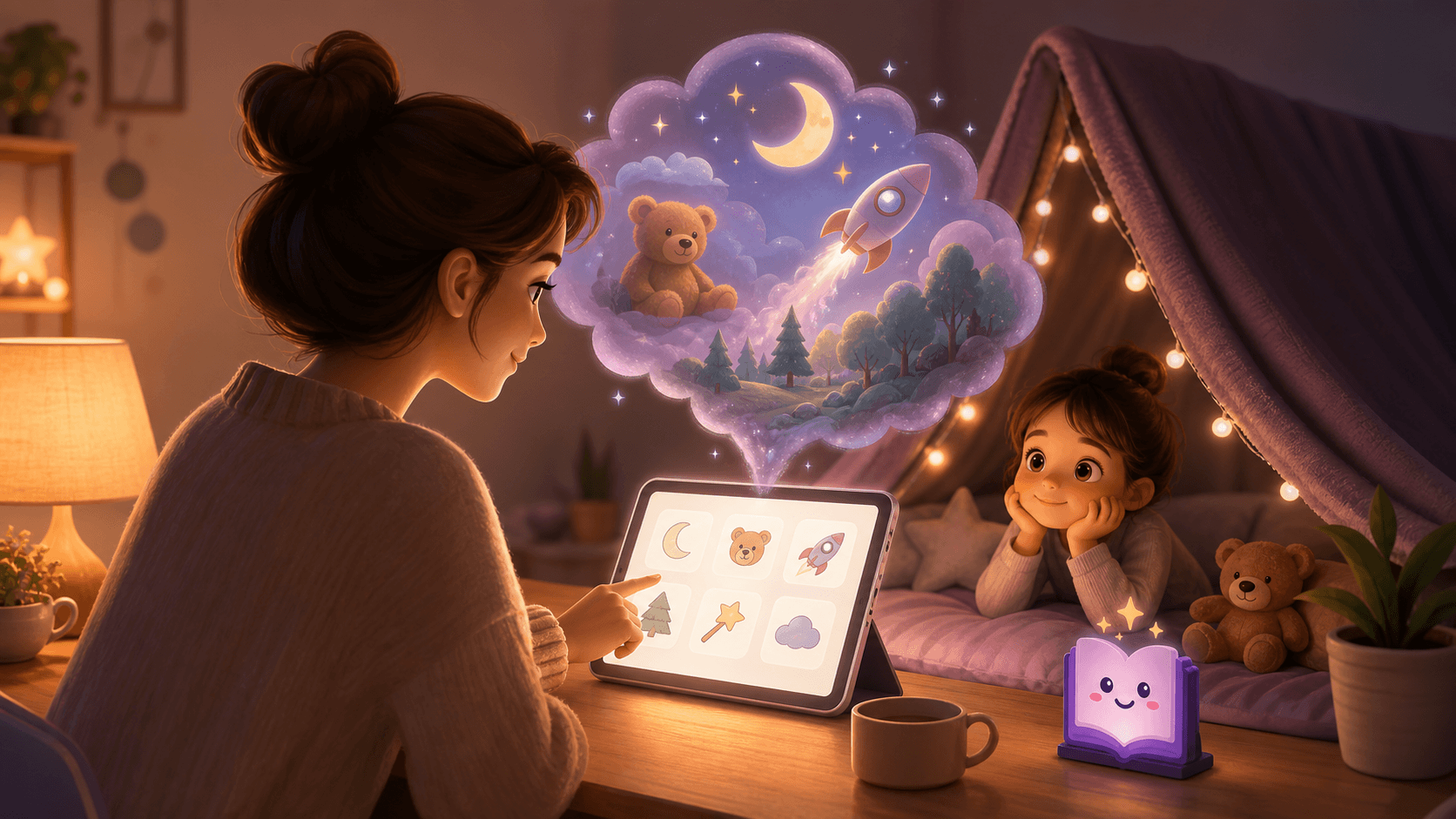
Try one gentle question:
- "What should the little owl pack?"
- "Should the boat go fast or slow?"
- "What color should the sleepy castle be?"
- "Where should the character rest at the end?"
One question is enough.
The point is connection, not a quiz.
Personalized Stories Help Parents When Ideas Run Out
Parents often want bedtime to feel warm, but they are also tired.
That is where personalization is practical.
You do not need a perfect plot if you have a simple pattern:
- Name the child.
- Add one favorite thing.
- Give the character one tiny problem.
- Solve it calmly.
- End in sleep, home, or comfort.
Example:
"Maya and the sleepy fox found a lantern that was too bright for bedtime. Together they taught it to glow softly, like a star under a blanket. When the room became gentle and warm, the fox curled up, and Maya listened to the quiet until her eyes felt heavy."
That is enough for a 2-minute story.
Parents who want more variety can use bedtime story ideas for kids, learn how to make up a bedtime story, or use an AI bedtime story generator for kids when they need a starting point.
AI is not the point.
The point is making parent-led storytelling easier.
Personalization Works Best When It Stays Calm
Not every personalized story is good for bedtime.
A story can be personal and still be too exciting, too long, too funny, or too intense.
For bedtime, avoid personalizing toward:
- battles
- cliffhangers
- scary creatures
- fast chase scenes
- big surprises
- competition
- endings that invite "one more chapter"
Personalize toward:
- comfort
- soft adventure
- familiar routines
- gentle problem-solving
- sleepy sensory details
- reassuring endings
The difference is simple.
"You are a dragon rider racing through lightning" may be exciting.
"You are a dragon keeper helping a baby dragon find its cozy cave" is more bedtime-friendly.
For a deeper safety framework, see Are AI Bedtime Stories Safe for Kids? and Child-Safe AI.
Personalized Books, Apps, and Made-Up Stories
Parents now have 3 main ways to create personalized stories:
| Format | Best for | Watch out for |
|---|---|---|
| Made-up parent stories | Warmth, flexibility, connection | Parents may run out of ideas |
| Personalized books | Keepsake stories and repeat reading | Less flexible night to night |
| Personalized story apps | Fresh variety, narration, illustrations | Should stay parent-led and age-aware |
The category is growing quickly. Personalized children's book companies helped prove that children respond strongly to seeing themselves in a story, while newer AI story tools have made custom stories faster to create. Google added a Gemini Storybook feature in 2025 that creates 10-page illustrated stories with read-aloud narration, showing how mainstream personalized story creation has become.
But for bedtime, the winning format is not the one with the most features.
It is the one that helps the child settle while preserving the parent-child connection.
That is why Lulawe focuses on personalized bedtime storytelling rather than generic story generation. A good bedtime story should feel personal, calm, emotionally safe, and easy for a parent to guide.
A Simple Formula for Tonight
Use this 5-part formula:
[Child's name] meets [gentle character] in [safe setting]. They solve [tiny problem] by [kind action]. The story ends with [home, sleep, or comfort].
Examples:
| Child interest | Bedtime story idea |
|---|---|
| Dinosaurs | "A tiny dinosaur learns to tiptoe through the moon garden" |
| Space | "A sleepy astronaut parks the stars for the night" |
| Trains | "A little train carries dreams to every pillow" |
| Fairies | "A fairy folds the last sunbeam into a blanket" |
| Ocean | "A whale hums the reef into quiet" |
For ages 2 to 4, keep the plot tiny and repetitive.
For ages 5 to 7, add a small choice or problem.
For ages 8 to 10, let the child shape a character, setting, or ending.
If you want age-specific guidance, see personalized bedtime stories by age.
What Parents Should Remember
Personalized bedtime stories work because they combine 2 things children need at night:
- imagination
- emotional familiarity
The child gets to go somewhere new without feeling lost.
Their name, interests, family details, or daily experiences become a bridge into the story. The parent stays present as the guide. The ending returns the child to safety, quiet, and sleep.
That is why children ask for these stories again.
They are not just asking for more content.
They are asking to feel known.
And at bedtime, feeling known is often the most calming story of all.