An AI bedtime story generator for kids creates a personalized children's story from details a parent provides, such as the child's age, name, interests, tone, and story goal. The best generators are parent-led, age-aware, privacy-conscious, and designed to create calm stories that fit naturally into bedtime.
Parents do not usually need more content at bedtime.
They need a story that works tonight.
That is where AI bedtime story generators can help: they turn a few parent choices into a fresh story, often in seconds. A child who loves dinosaurs can become the gentle explorer. A child nervous about the dark can meet a little star who learns to glow softly. A sibling pair can share the same adventure.
Used well, AI can make bedtime stories feel more personal.
Used carelessly, it can make bedtime too long, too digital, too exciting, or too generic.
This guide shows how to use an AI bedtime story generator for kids in a way that stays safe, calm, and useful.
Quick Answer: How Should Parents Use an AI Bedtime Story Generator?
Use an AI bedtime story generator before the final wind-down window, not after lights out negotiation has already started.
A good parent workflow is:
- Choose the child's age, theme, and mood.
- Add one or two safe personal details.
- Ask for a short, calm story with a reassuring ending.
- Review the story quickly.
- Read it aloud as part of the normal bedtime routine.
The parent remains the storyteller. The AI provides the draft.
What Is an AI Bedtime Story Generator for Kids?
An AI bedtime story generator is a tool that uses artificial intelligence to create a bedtime story from a prompt or guided form.
For children, the important word is not just "AI." It is "bedtime."
A bedtime story generator for kids should create stories that are:
- age-appropriate
- emotionally safe
- easy to read aloud
- not too long
- low-stimulation
- gently personalized
- finished with a clear, calming ending
That is different from a general creative writing tool, which may optimize for novelty, drama, humor, or surprise.
At bedtime, surprise is not always your friend.
How AI Bedtime Story Generators Work
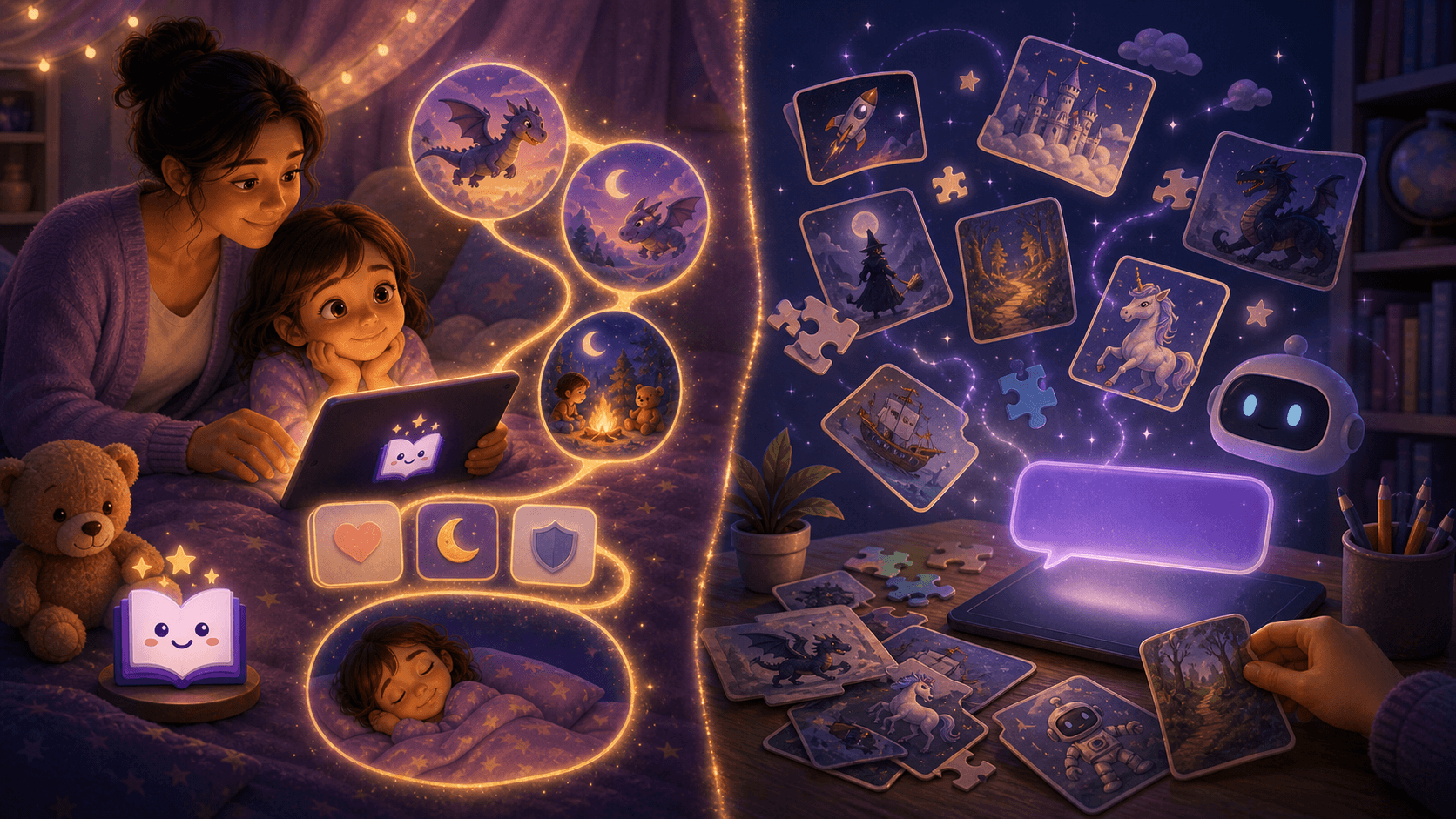
Most AI story generators follow the same basic pattern:
| Step | What happens | Parent choice |
|---|---|---|
| Input | The parent provides details | Age, name, theme, mood, length |
| Generation | The AI writes a story draft | Tool creates characters, setting, and plot |
| Review | The parent checks the output | Remove anything too scary, long, or intense |
| Reading | The story becomes part of bedtime | Parent reads aloud or uses gentle audio |
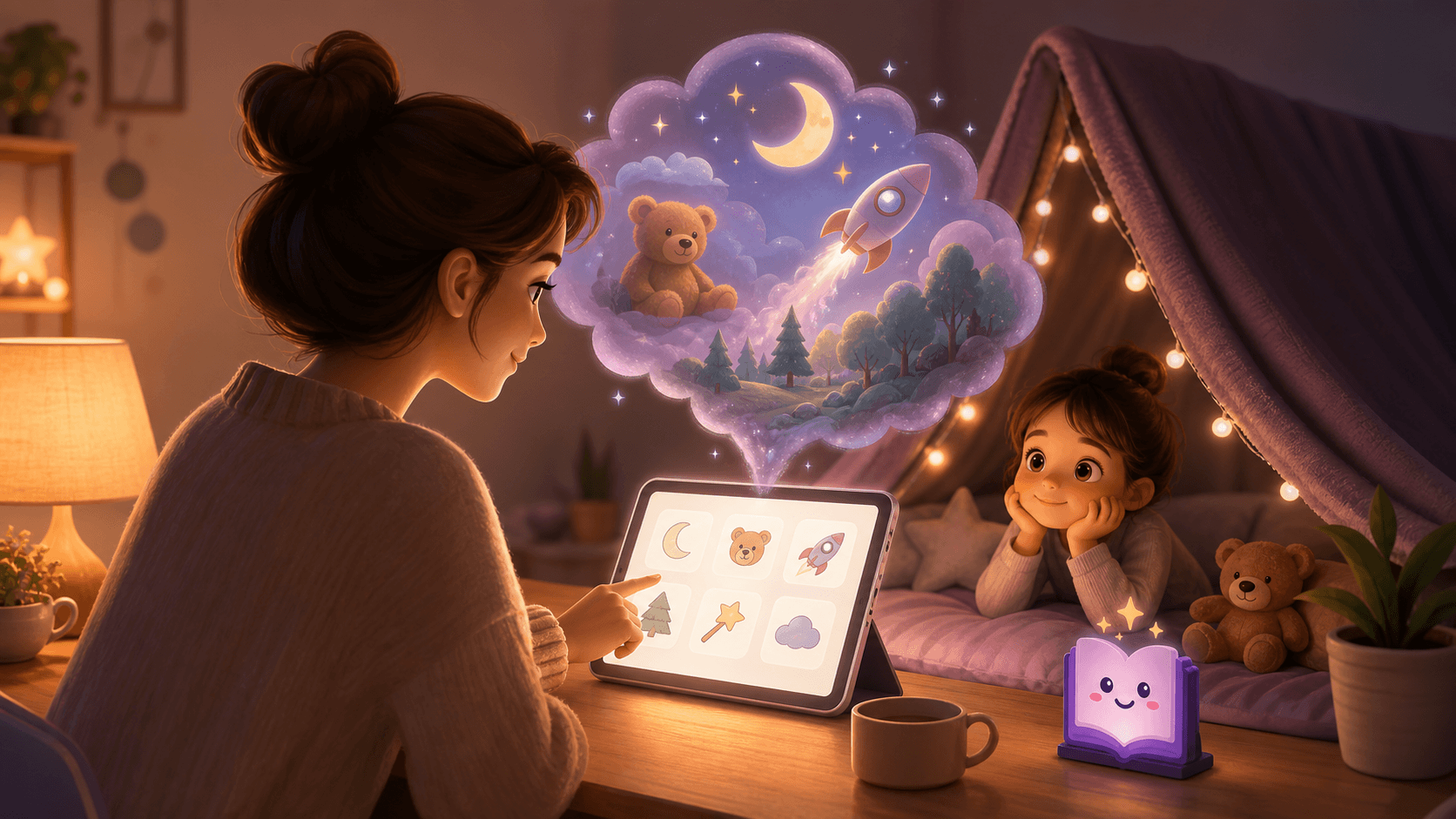
Child-specific apps may replace a blank prompt box with guided choices. That is often easier for tired parents because the app asks the questions that matter: age, tone, characters, setting, and bedtime goal.
Generic AI tools can also write stories, but the parent has to do more of the story design.
What Details Should You Add?
The best AI bedtime stories usually come from a small number of specific details.
Use this simple formula:
Write a short, calm bedtime story for a [age]-year-old named [name] who loves [interest]. The story should feel [mood], include [gentle theme], and end with the character safe, sleepy, and ready for bed.
Good details to include:
- first name or nickname
- age
- favorite animal
- favorite toy
- current interest
- gentle story mood
- one bedtime goal
Avoid overloading the prompt. Too many details can make the story feel busy instead of soothing.
Safe Prompt Examples
Here are examples parents can adapt.
| Need | Example prompt |
|---|---|
| Calm toddler story | Write a 5-minute bedtime story for a 3-year-old who loves bears. Keep it repetitive, gentle, and sleepy. |
| Personalized adventure | Write a calm story about a child named Leo and a tiny moon boat. Make the adventure peaceful and end at bedtime. |
| Anxiety support | Write a reassuring bedtime story for a child who feels nervous in the dark. No scary scenes. End with comfort and sleep. |
| Sibling story | Write a gentle bedtime story about two siblings sharing a blanket fort and learning to take turns. |
| Confidence story | Write a warm bedtime story about a child learning to try something new, with a soft ending and no big conflict. |
For a larger library of ideas, use 50 Bedtime Story Ideas for Kids or the guide on how to make up a bedtime story.
What to Avoid in an AI Bedtime Story Prompt
Avoid prompts that push the story toward action or intensity.
For bedtime, be careful with:
- battles
- monsters
- villains
- punishments
- chase scenes
- cliffhangers
- "make it hilarious"
- "make it epic"
- "make it surprising"
Those prompts can create good daytime stories. They are less useful when the goal is sleep.
Also avoid entering sensitive personal details. An AI story can feel personal without using a child's full name, school, address, medical information, or private family events.
For more on this, see Are AI Bedtime Stories Safe for Kids? and Child-Safe AI.
Free vs Paid AI Bedtime Story Generators
Free tools can be helpful, especially for parents who want quick inspiration.
But there are tradeoffs.
| Feature | Free generic generator | Child-specific story app |
|---|---|---|
| Cost | Free or limited free tier | Usually free trial or paid plan |
| Parent prompting | More manual | More guided |
| Age fit | Depends on instructions | More likely built into flow |
| Saved child profile | Usually no | Often yes |
| Safety controls | Varies widely | Should be clearer and child-focused |
| Repeat bedtime use | Can feel repetitive to set up | Easier across many nights |
The best choice depends on your goal.
If you need one quick idea, a free generator may be enough. If you want repeated personalized stories that remember a child's age, interests, characters, and family moments, a dedicated bedtime story app is usually more practical.
AI Story Generator vs Bedtime Story App
A generic AI story generator is flexible. A bedtime story app is focused.
That focus matters because children's bedtime stories are not just short fiction. They sit inside a family routine. They need a particular emotional shape.
| Question | Generic AI story generator | Bedtime story app for kids |
|---|---|---|
| Who designs the structure? | Parent prompt | App workflow plus parent choices |
| Is it built for bedtime? | Not necessarily | Yes, if child-specific |
| Does it remember profiles? | Usually no | Often yes |
| Is output consistent? | Variable | More predictable |
| Best use | Flexible one-off stories | Repeated family bedtime use |
The deeper comparison is here: AI Bedtime Story App vs Generic AI Story Generator.
How to Make AI Stories More Personal
Personalization works best when it feels familiar, not crowded.
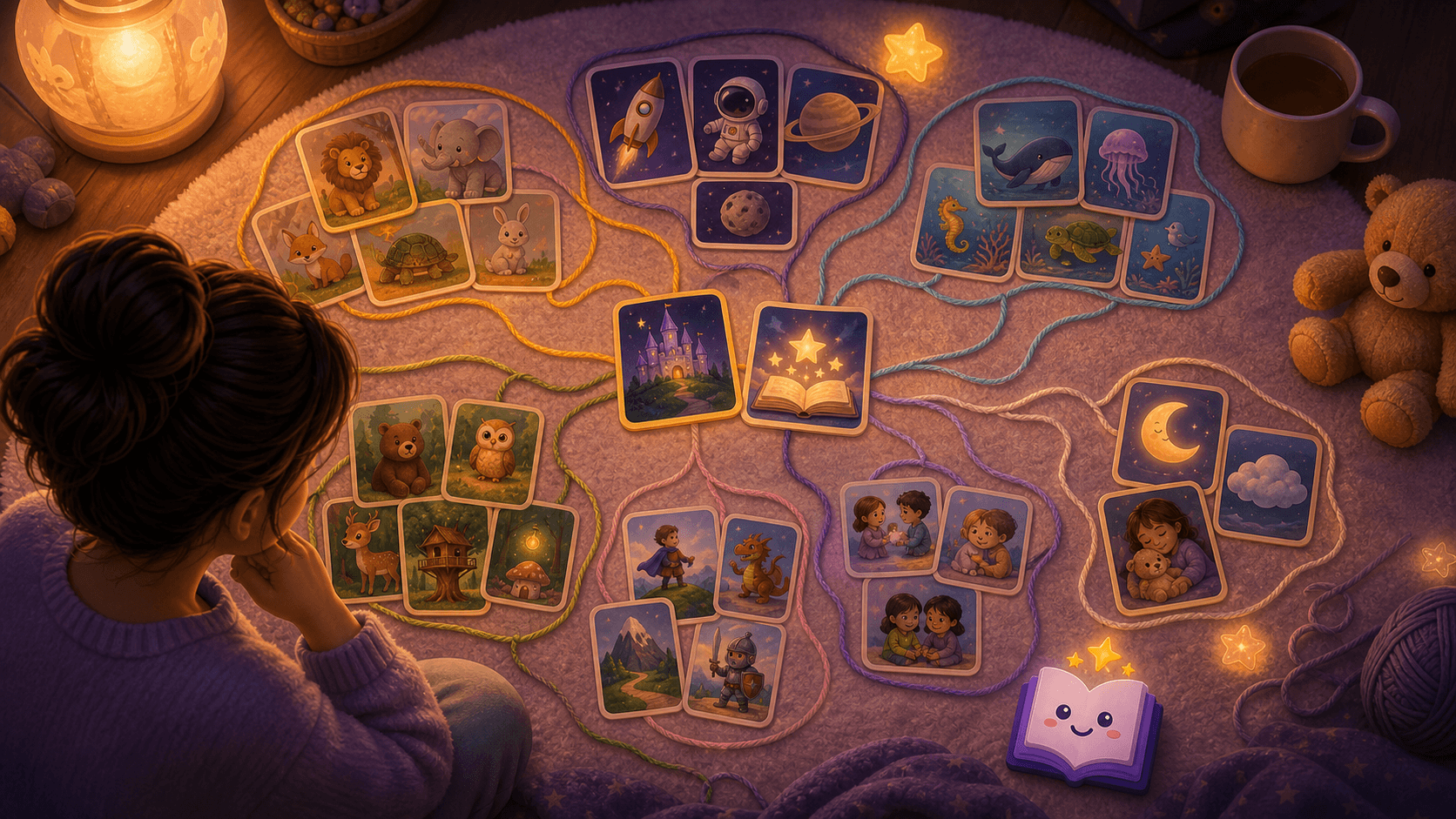
Instead of adding ten facts, choose one detail from each category:
| Category | Example |
|---|---|
| Child | name, age, favorite color |
| Interest | dinosaurs, trains, fairies, space |
| Feeling | sleepy, brave, curious, calm |
| Setting | bedroom, garden, moon, forest |
| Goal | sharing, confidence, winding down |
This creates enough detail for a personalized bedtime story without making the story feel like a checklist.
How Long Should an AI Bedtime Story Be?
Shorter is usually safer at bedtime.
Use this rough guide:
| Age | Useful length |
|---|---|
| 1-2 | 2-5 minutes |
| 3-4 | 5-10 minutes |
| 5-6 | 8-15 minutes |
| 7-8 | 10-20 minutes |
| 9-10 | 15-25 minutes |
If the child is already overtired, choose the shorter end.
If the story becomes a negotiation for more chapters, it is no longer helping the routine.
A Simple Parent Prompt Template
Copy this structure and change the details:
Write a calm bedtime story for a [age]-year-old named [name]. The child loves [interest]. The story should be [length] minutes long, use simple age-appropriate language, include one gentle problem, and end with the character safe, cozy, and ready to sleep. Avoid scary scenes, villains, cliffhangers, and fast action.
This prompt works because it tells the AI:
- who the story is for
- how long it should be
- what emotional tone to use
- what not to include
- how the ending should feel
That final instruction is important. At bedtime, the ending carries the child into sleep.
Final Takeaway
An AI bedtime story generator can be a useful parent tool when it creates calm, personal, age-appropriate stories without taking over bedtime.
Use it before the final routine, review the story, keep details privacy-safe, and read it in your own voice when you can.
The goal is not to automate connection.
The goal is to make connection easier on tired nights.