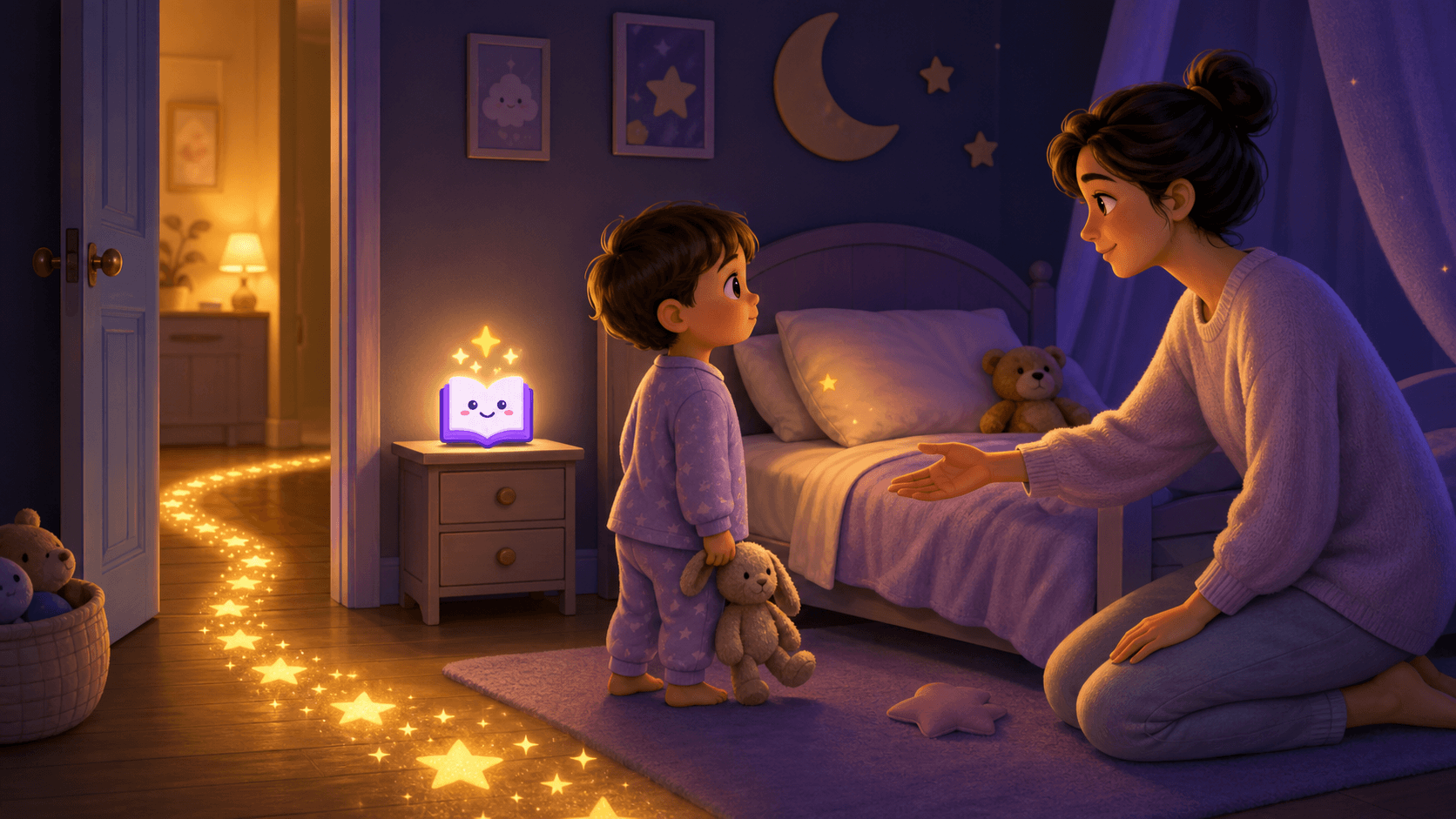
Toddler bedtime tantrums usually improve when bedtime becomes predictable, short, and emotionally safe: connection first, one calm story, a clear endpoint, and the same response every time the tantrum starts. The goal is not to win a power struggle. The goal is to make bedtime boringly consistent and easier for your toddler to accept.
Bedtime tantrums can feel different from daytime tantrums.
Everyone is tired. The room is darker. Parents are out of patience. The toddler knows this is the last chance to ask for water, another cuddle, another book, another parent, or one more trip out of bed.
That is why a bedtime tantrum plan has to start before the crying starts.
If you wait until your toddler is already screaming on the floor, you are trying to build a routine in the hardest possible moment. Instead, make the evening sequence so clear that everyone knows what happens next.
Quick Answer
Use this 7-step plan for toddler bedtime tantrums:
- Move the wind-down earlier.
- Feed connection before the routine ends.
- Reduce choices to two simple options.
- Make one bedtime story the clear endpoint.
- Use the same goodnight phrase every night.
- Respond to tantrums with calm, short words.
- Repeat the plan for at least one week before changing it.
This approach works because toddlers are still learning emotional regulation. They need warm boundaries, not a different bedtime negotiation every night.
Why Toddlers Have Tantrums at Bedtime
Toddler bedtime tantrums are rarely about one thing. They usually come from a mix of tiredness, control, separation, and overstimulation.
| Driver | What it looks like | What helps |
|---|---|---|
| Overtiredness | Wild energy, crying over small requests, frantic refusal | Earlier routine and quieter wind-down |
| Bedtime resistance | "No bed," running away, refusing pajamas | Predictable order and calm limits |
| Bedtime procrastination | Water, toilet, toy, another question, another hug | Pre-bed checklist and no new requests after lights out |
| Separation anxiety | Panic when parent leaves | Extra connection before goodbye and gradual check-ins |
| Too much stimulation | Screens, wrestling, loud play, bright lights | Screen-free, low-energy final hour |
| Need for control | Fighting every instruction | Two small choices inside firm boundaries |
Mayo Clinic's tantrum guidance notes that children who do not get enough rest and quiet time can become short-tempered. That matters at bedtime because a tired toddler may look energetic, but their nervous system is often less able to handle limits.
Step 1: Start the Wind-Down Before Your Toddler Looks Tired
Many bedtime tantrums begin because the routine starts too late.
Overtired toddlers can look loud, fast, silly, angry, or wired. By the time they seem obviously sleepy, they may already be past the easiest sleep window.
Try moving the first calm step 15 to 30 minutes earlier for one week.
The wind-down does not need to be complicated:
- dim lights
- quiet play
- bath or wash
- pajamas
- teeth
- one calm story
- goodnight phrase
If the tantrum usually starts during pajamas, start the routine before your toddler is already dysregulated. If the tantrum usually starts when the story ends, keep the story but make the ending more predictable.
Step 2: Give Connection Before the Boundary
Some toddlers melt down at bedtime because the end of the day feels like a loss of connection.
They may have been busy all day. You may have been busy all day. Then suddenly the quietest, closest moment arrives right before separation.
Build connection into the routine before the hard boundary:
- 5 minutes of floor play before pajamas
- one short chat about the day
- a cuddle during the story
- a predictable "best part of today" question
- a loving phrase you repeat every night
This helps because the boundary does not feel like rejection. You are showing your toddler, "I am close, and bedtime still happens."
Step 3: Offer Two Choices, Not Open-Ended Control
Toddlers often fight bedtime because they want control.
Give control in tiny, parent-approved places:
| Instead of asking | Say |
|---|---|
| "What do you want to wear?" | "Blue pajamas or star pajamas?" |
| "Which books do you want?" | "Bear story or moon story?" |
| "Are you ready for bed?" | "Do you want to hop to bed or tiptoe to bed?" |
| "What do you need?" | "Water now, then story." |
HealthyChildren.org, from the American Academy of Pediatrics, recommends regular daily routines and a simple bedtime pattern for young children. Limited choices fit that idea: your toddler gets some agency, while the parent keeps the routine intact.
Step 4: Make the Story the Endpoint
A bedtime story can reduce tantrums when it becomes the closing signal, not another item to negotiate.
Choose one calming bedtime story before the routine starts. Keep it short enough that you can finish it even on a hard night.
The story should be:
- gentle
- familiar or personalized
- not scary
- not full of cliffhangers
- easy to end
- followed by the same phrase every night
Example:
We read one story. Then I say, "You are safe, teddy is here, and it is sleep time."
The same story ending matters. Toddlers learn through repetition. If every night ends differently, they keep testing which version will happen tonight.
This is where a personalized bedtime story can be useful. A story that includes your toddler's name, favorite blanket, stuffed toy, or room can make the child feel seen before the goodbye. Lulawe is built for that kind of story: a calm, child-specific bridge from connection to sleep.
Step 5: Use the "Done List"
Many bedtime tantrums are powered by last-minute requests.
Before lights out, say what is already complete:
- Potty is done.
- Water is done.
- Teeth are done.
- Story is done.
- Cuddle is done.
- Teddy is here.
- Now it is sleep time.
Then repeat the same phrase if the tantrum starts:
Bedtime is done. I love you. It is sleep time.
Keep your voice low. Keep your words short. Long explanations can accidentally restart the negotiation.
Step 6: Respond Without Adding New Rewards
During a tantrum, your first job is safety.
Make sure your toddler is not hurting themselves, another person, or something dangerous. Stay close enough to be safe, but do not turn the tantrum into a long debate.
Cleveland Clinic's tantrum guidance emphasizes a calm adult presence. For bedtime, that usually means fewer words, not better arguments.
Try this:
- Get low and calm.
- Say one sentence: "You are upset, and it is still sleep time."
- Pause.
- Repeat the bedtime step when your toddler is calm enough.
- Do not add screens, snacks, extra stories, or big play.
This does not mean being cold. It means being steady.
Avoid:
- "Fine, one more episode."
- "Fine, three more books."
- "If you stop crying, you can come downstairs."
- "If you keep crying, no stories tomorrow."
Those responses teach the tantrum that bedtime rules are flexible when emotions get big.
Step 7: Keep the Plan Long Enough to Learn From It
Many bedtime plans fail because they change every two nights.
Try one consistent plan for at least seven nights unless there is a safety or health concern.
Track only three things:
| Night | Tantrum length | Main trigger |
|---|---|---|
| 1 | 25 minutes | Story ended |
| 2 | 18 minutes | Parent left room |
| 3 | 12 minutes | Wanted water |
| 4 | 8 minutes | Pajamas |
You are looking for a pattern, not perfection.
If the tantrums are getting shorter, stay the course. If they are getting longer, look for the driver: timing, fear, separation, hunger, nap schedule, or an unclear boundary.
If the Tantrum Is Really Fear
Some bedtime tantrums are not limit testing. They are fear.
Fear-based tantrums often include:
- panic when the parent moves away
- fear of the dark
- worry about being alone
- repeated checking
- body tension that does not look playful
- distress that continues even when the parent is calm
In that case, pair limits with reassurance. Read Bedtime Stories for Kids with Anxiety, separation anxiety at bedtime, and child won't sleep without parent.
You can still keep bedtime consistent. Just make the goodbye more gradual.
For example:
| Nights | Parent position |
|---|---|
| 1-2 | Sit beside the bed, quiet and boring |
| 3-4 | Sit halfway across the room |
| 5-6 | Sit near the door |
| 7+ | Brief check-ins after goodnight |
Mayo Clinic's child sleep guidance recommends using a calming routine and comfort object when a child struggles to fall asleep alone. That is a good fit for anxious bedtime tantrums.
A Bedtime Tantrum Script
Before the routine:
Tonight we will do pajamas, teeth, one story, cuddle, and sleep.
Before the story:
You can choose moon story or bear story. After the story, it is sleep time.
When the story ends:
Story is done. I love you. Teddy is here. It is sleep time.
During the tantrum:
You are upset. I am here. It is still sleep time.
If your toddler gets out of bed:
Back to bed. It is sleep time.
The script is intentionally plain. At bedtime, clever words matter less than consistent words.
What Not to Do
Try to avoid:
- starting bedtime after your toddler is already overtired
- making the last hour bright, loud, or screen-heavy
- offering unlimited choices
- adding new rewards after the tantrum starts
- restarting the whole routine
- making threats you do not want to enforce
- removing all reassurance from a fearful child
- changing the plan every night
If your toddler is unsafe, climbing, hitting, vomiting repeatedly, struggling to breathe, snoring heavily, or showing signs of pain, treat that as a health or safety issue first.
A Simple Lulawe Story Prompt
Use this prompt for a calming personalized story:
Write a short bedtime story about [child's name] feeling upset when bedtime begins, then choosing one cozy story, holding [favorite toy], and learning that the room is safe after the goodnight phrase.
Keep the story short. The goal is not to entertain your toddler back into high energy. The goal is to help them feel understood, settled, and ready for the same goodnight every night.
Final Takeaway
Toddler bedtime tantrums are hard because they happen when the whole family is tired.
But the plan can be simple:
connection before the boundary, two small choices, one calming story, a clear done list, and the same calm response every time.
Do that for a week.
Then adjust based on what you learn, not based on the hardest five minutes of the night.