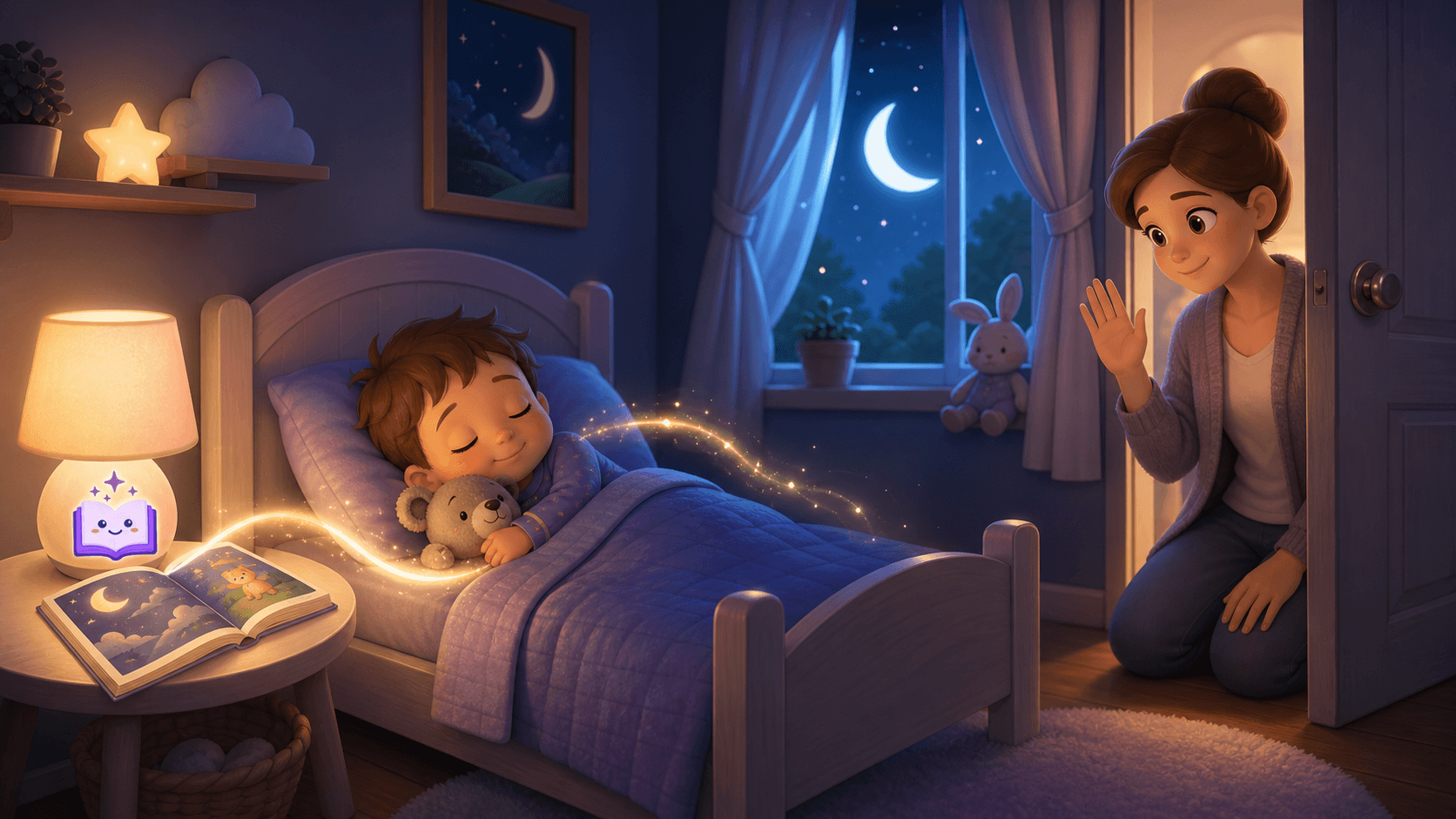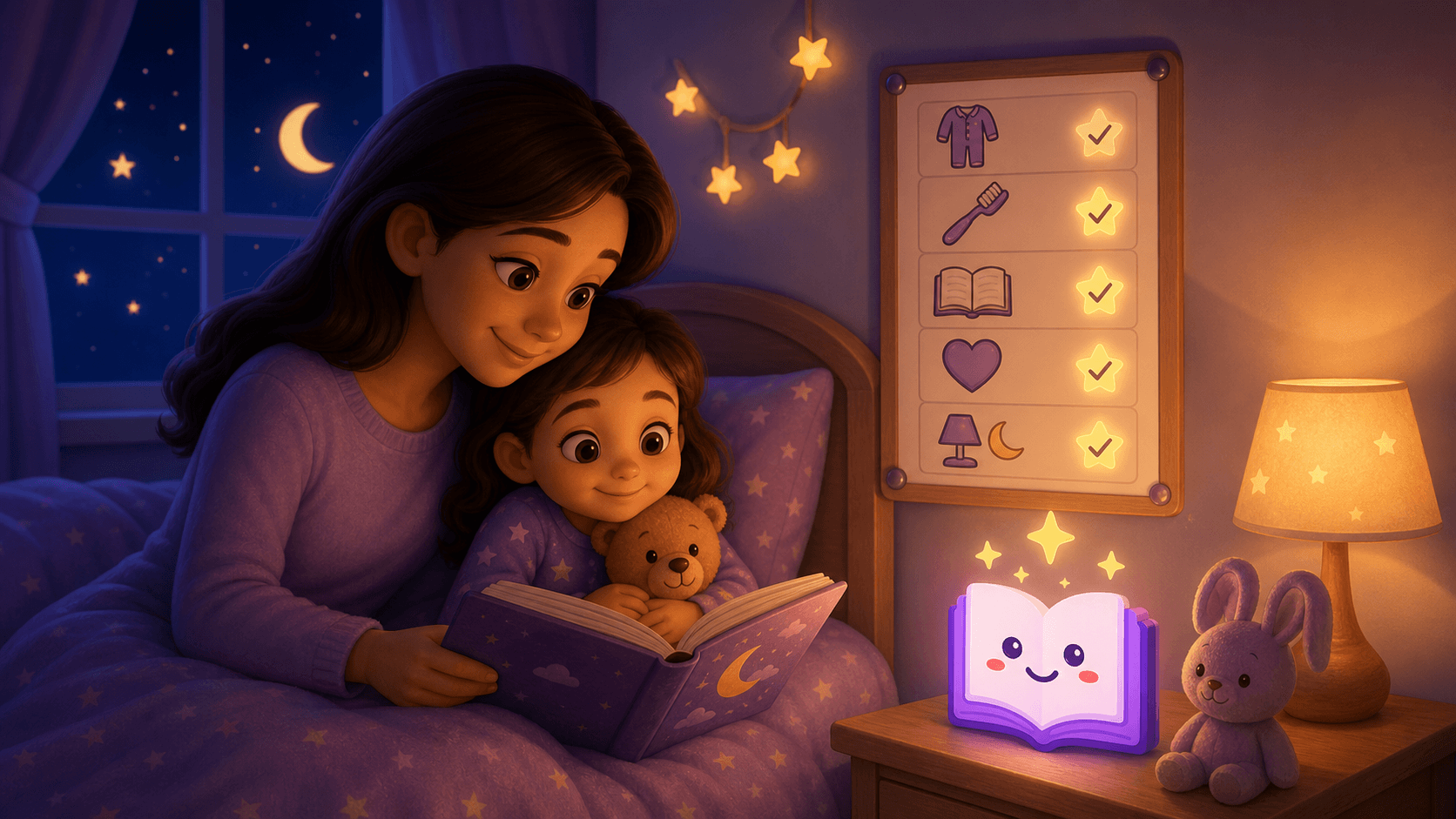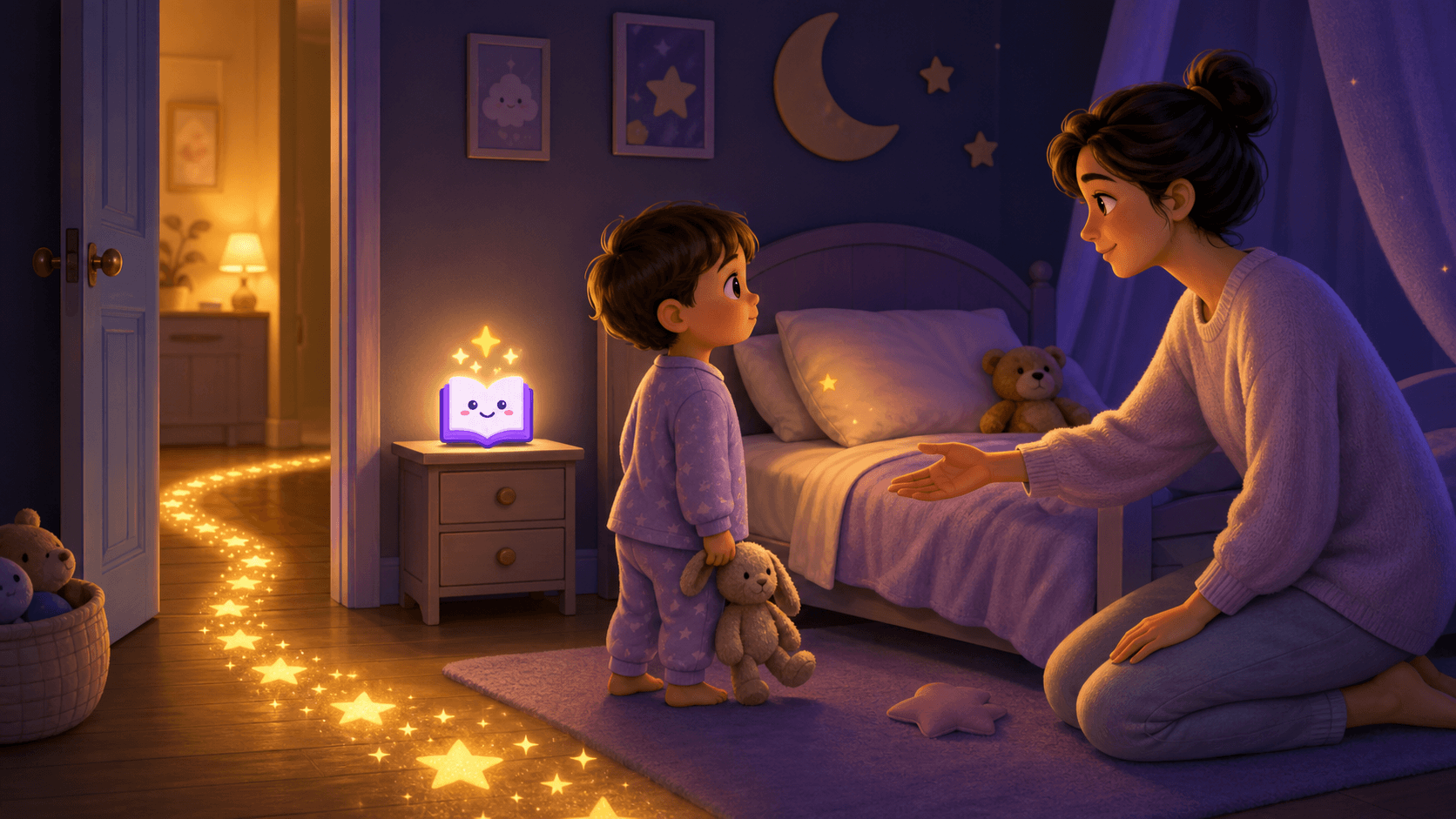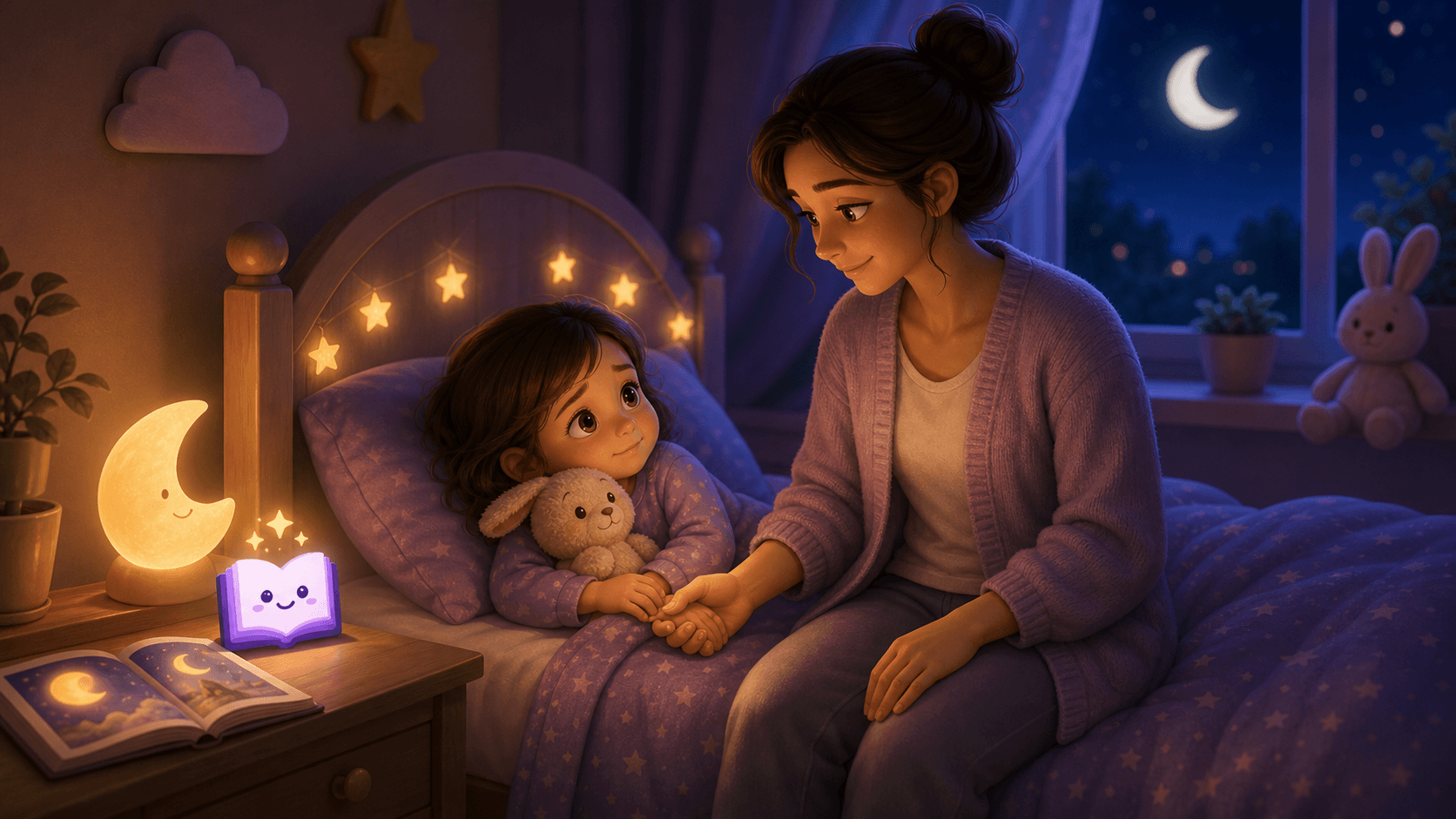
If your child won't sleep without a parent, the goal is to replace parent-dependent sleep with a predictable routine, positive sleep cues, and gradual independence. Give connection before lights out, then slowly reduce how much parent presence your child needs to fall asleep.
Many children sleep best when a parent is nearby.
That makes sense. Parents are safety, warmth, comfort, and regulation.
The problem begins when a child can only fall asleep with a parent present, then wakes in the night and needs the same condition again.
This is not a failure. It is a pattern. If the whole evening needs more structure first, start with the kids bedtime routine checklist.
And patterns can change gently.
Quick Plan
Use this order:
- Understand whether the driver is anxiety, habit, or timing.
- Build a predictable bedtime routine.
- Give focused connection before lights out.
- Add one calming story as the transition.
- Introduce self-sustaining sleep cues.
- Move parent presence back gradually.
- Respond to night wakings with the same short script.
The goal is not to make your child need you less emotionally. The goal is to help them feel safe when the bedtime routine is finished.
Why Children Need a Parent to Fall Asleep
Common reasons include:
| Reason | What it looks like |
|---|---|
| Separation anxiety | Distress when parent leaves |
| Parent-dependent sleep association | Child needs parent beside them to fall asleep |
| Fear of the dark | Room feels unsafe once parent leaves |
| Overtiredness | Child becomes dysregulated at bedtime |
| Inconsistent routine | Child keeps checking what happens next |
| Night waking pattern | Child wakes and needs the same parent help again |
If the child is tearful or fearful, start with separation anxiety at bedtime. If the child wakes repeatedly needing you, read about sleep associations.
Parent Presence as a Sleep Association
A sleep association is something a child connects with falling asleep.
Parent presence can become a strong sleep association when the child always falls asleep with:
- parent lying beside them
- parent holding their hand
- parent rocking them
- parent sitting in the room
- parent returning after every call
This is not wrong. It is often loving and developmentally understandable.
It becomes a problem when the family wants sleep to be more sustainable and the child cannot return to sleep without recreating the same parent help.
Step 1: Add More Connection Before the Goodbye
Some children cling at bedtime because the goodbye feels like the first quiet connection of the day.
Before trying to leave faster, add connection earlier:
- 10 minutes of focused play before the routine
- a short chat about the day
- one predictable story
- a cuddle with a clear ending
- a repeated goodnight phrase
Connection before separation makes the separation easier.
Step 2: Make the Story the Emotional Bridge
A bedtime story can help because it gives the child closeness before the parent leaves.
Choose a calming bedtime story that gently models:
- the child feeling safe
- the parent nearby
- the room being familiar
- the bed being cozy
- sleep coming naturally
A personalized bedtime story can be especially useful because the child hears their own name, blanket, room, teddy, or bedtime phrase inside the story.
The story becomes the bridge from parent closeness to sleep.
Step 3: Introduce Self-Sustaining Sleep Cues
Self-sustaining cues can remain after the parent leaves.
Examples:
- comfort object
- nightlight
- white noise
- same goodnight phrase
- story ending phrase
- picture near bed
- predictable check-in
These support self-settling, which means the child gradually learns to feel safe enough to fall asleep or return to sleep with less help.
Step 4: Use Gradual Withdrawal
Do not jump from lying beside your child to leaving completely if the child is anxious.
Try:
| Stage | Parent role |
|---|---|
| 1 | Lie nearby but reduce talking and touch |
| 2 | Sit beside the bed |
| 3 | Sit across the room |
| 4 | Sit near the door |
| 5 | Sit outside the door with brief check-ins |
| 6 | Goodnight phrase and leave |
Stay at each stage for a few nights or until the child is calmer.
The parent is still supportive. The support simply becomes lighter.
Step 5: Handle Night Wakings Consistently
Night wakings are normal. The issue is what the child needs to return to sleep.
If your child wakes and calls for you:
- Return calmly.
- Use the same phrase.
- Keep lights low.
- Avoid restarting the full bedtime routine.
- Return to your current gradual-withdrawal stage.
Example:
You are safe. It is still sleep time. I am nearby.
The response should be warm, but not exciting.
What Not to Do
Avoid:
- sneaking out after the child falls asleep
- changing the plan every night
- long negotiations after lights out
- shaming the child for needing you
- suddenly removing support from a highly anxious child
- making the story scary, dramatic, or cliffhanger-based
Sneaking out often makes anxious children more alert because they learn to monitor whether the parent is still there.
A Simple Personalized Story Pattern
Try a story like this:
A child named [name] loved bedtime cuddles. Every night, [name] and the parent read one cozy story. Then the parent said, "I am nearby, and your bed knows how to keep you safe." [Name] held their soft toy, listened to the quiet room, and learned that the goodnight always stayed, even after the parent stepped away.
This kind of story does not force independence. It makes independence feel safe.
When to Get Help
Consider professional support if:
- your child has severe separation anxiety
- sleep problems last for months without improvement
- the child is very distressed during the day too
- night wakings are extreme
- there are signs of pain, reflux, snoring, or breathing issues
- the family's sleep deprivation is unsafe
Bedtime stories and routines can help, but persistent or severe sleep distress deserves support.
Final Takeaway
If your child will not sleep without a parent, start with compassion.
The child is not broken. The routine has simply taught them that sleep begins with you there.
Build a new routine slowly: connection, story, comfort cue, repeated phrase, and gradually less parent presence.
That is how sleep starts to feel safe without you doing all the work.