A bedtime story for an ADHD child should be short, structured, low-stimulation, and easy to end. The best stories give the child a calm focus without adding suspense, fast action, endless choices, or a cliffhanger that keeps the brain working after lights out.
Some children need bedtime to become quieter slowly.
That can be especially true for children with ADHD traits, who may struggle with transitions, impulse control, body stillness, or stopping something interesting once it begins.
This guide is not medical advice and it is not a treatment plan. It is a parent-friendly way to choose stories that make bedtime less stimulating and more predictable.
Quick Answer
Choose stories that are:
- 3 to 8 minutes long
- predictable
- gently repetitive
- emotionally warm
- low-conflict
- easy to pause
- finished with the same phrase
Avoid stories that are:
- fast
- chaotic
- very funny
- suspenseful
- full of battles or chases
- open-ended
- hard to stop
Why Story Choice Matters
For some children, the wrong bedtime story wakes the brain up.
Fast plots can create more movement. Funny scenes can restart play. Cliffhangers can make the child ask questions after lights out.
A calming bedtime story does the opposite. It narrows attention, repeats a safe pattern, and ends clearly.
The story becomes a sleep cue: when this kind of story ends, the next thing is rest.
Best Story Structure
Use this shape:
- The character is in a familiar place.
- One small task needs finishing.
- The character slows down to finish it.
- The routine repeats.
- The character rests.
Example:
A child wants to finish building a tower before bed. The tower gets one final block, the child takes one slow breath, the blocks rest in a basket, and the child gets into bed knowing the tower can wait until morning.
This structure respects the child's desire to keep going while still teaching a stop point.
What to Avoid
Avoid bedtime stories with:
- "what happens next?" endings
- timers that feel like a race
- competition
- slapstick chaos
- loud sound effects
- big emotional swings
- too many characters
- too many choices
The goal is not to remove fun from stories. It is to move high-energy fun earlier in the day.
A Bedtime Story Template
Use this template with a child, a paper book, or an AI story generator:
Write a short, calm bedtime story for a [age]-year-old. The main character has lots of ideas at bedtime and learns to put one idea safely away for tomorrow. Use simple language, repeated phrases, no villains, no chases, and a clear ending. Make the story slower as it goes.
For AI prompts, see Bedtime Story Prompts for Kids.
Ready-to-Read Story: The Tomorrow Shelf
Leo had a busy brain.
At bedtime, his brain found ideas everywhere.
One idea was under the pillow.
One idea was in his sock.
One idea was halfway inside tomorrow.
"I need to remember all of them," Leo said.
Dad pointed to a small shelf near the bed.
"That is what the tomorrow shelf is for."
Leo looked at the shelf.
"Can ideas sit there?"
"Yes," Dad said. "Ideas do not mind waiting when they know where to rest."
So Leo whispered the first idea.
"Build a blanket tunnel."
Dad nodded. "Tomorrow shelf."
Leo whispered the second idea.
"Draw a moon map."
"Tomorrow shelf."
Leo whispered the third idea.
"Ask why socks disappear."
Dad smiled. "Very important. Tomorrow shelf."
The shelf did not glow or sing or do anything exciting.
It simply held the ideas.
Leo's room became quieter.
His blanket became warmer.
His pillow became softer.
Dad said, "Ideas are safe. Body is resting. Morning will come."
Leo repeated, "Ideas are safe. Body is resting. Morning will come."
And because the ideas had a place to wait, Leo did not have to hold them all night.
He closed his eyes.
The shelf kept tomorrow.
Leo kept sleep.
Routine Tips That Make the Story Work
A story works better when the rest of bedtime supports it.
Use:
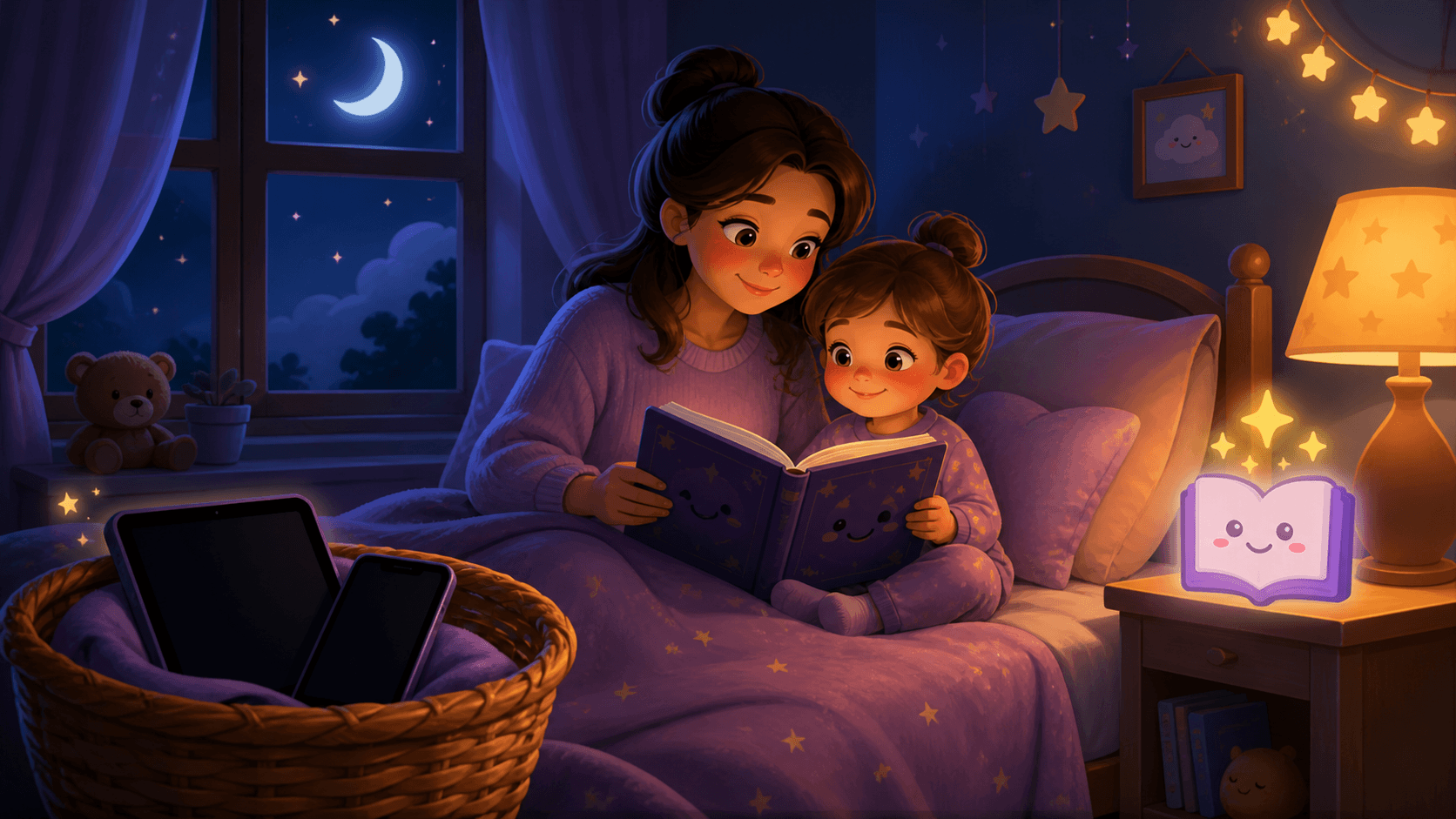
- a screen cutoff before the routine
- the same story spot
- one story limit
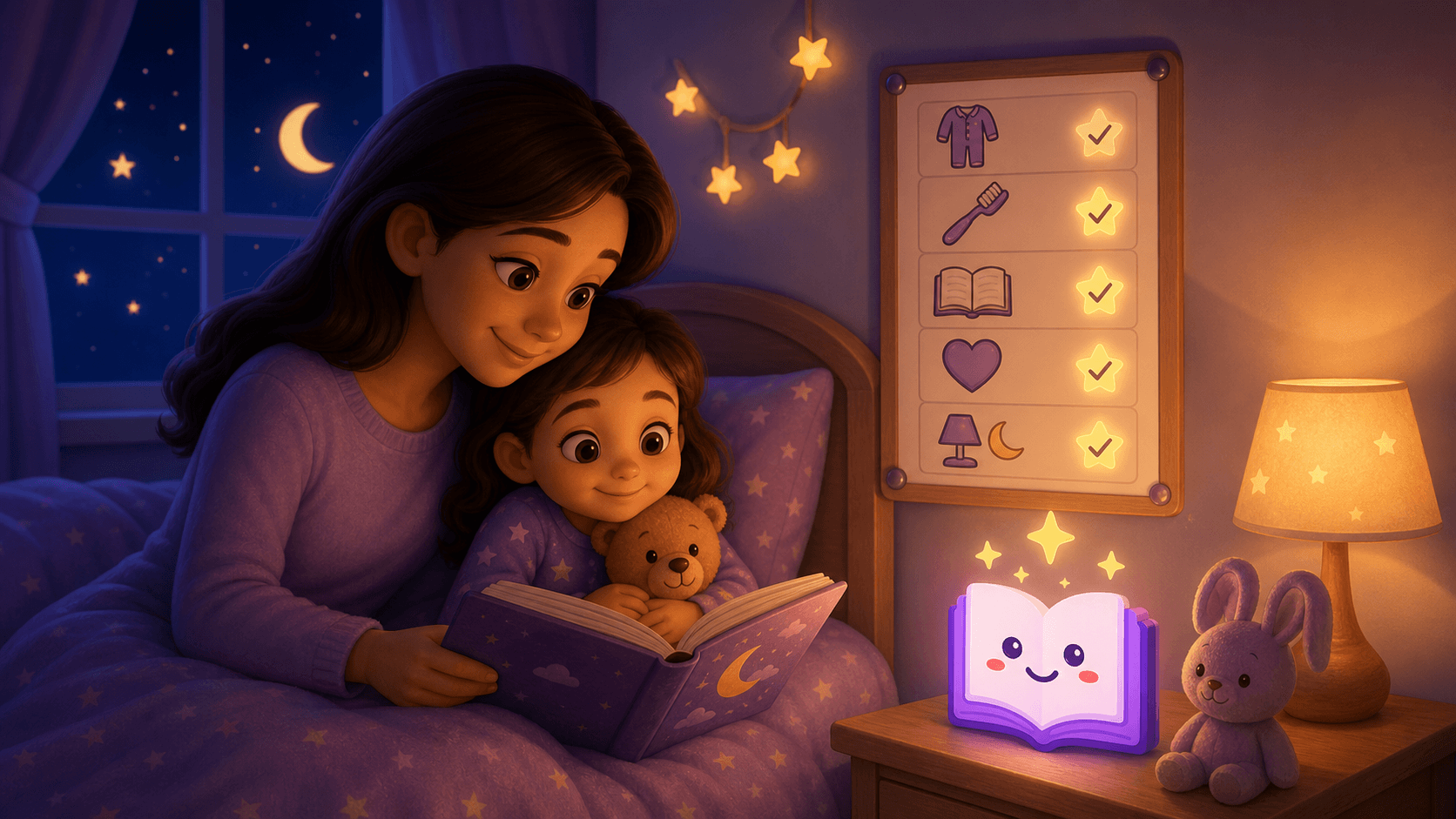
- a visible checklist
- a short phrase after the story
- a boring return-to-bed script
Try the Kids Bedtime Routine Checklist and Screen-Free Bedtime Routine for Kids for the surrounding structure.
Story Length Guide
| Child's age | Start with |
|---|---|
| 3-4 | 3-5 minutes |
| 5-6 | 5-8 minutes |
| 7-8 | 8-10 minutes |
| 9+ | One short chapter |
If the child becomes more animated during the story, shorten it or choose a calmer plot next time.
Audio Stories and ADHD
Audio can help if it removes reading pressure and creates a steady rhythm.
Audio can hurt if it creates another choice loop.
Use audio only when:
- the story is preselected
- the device is out of reach
- volume is low
- autoplay is off
- the child knows there is one story only
If the child keeps asking to change tracks, switch to a parent-read story.
When to Ask for Help
Talk with a pediatrician or qualified clinician if sleep problems are persistent, severe, or affecting school, mood, safety, or family wellbeing.
Also ask for help if the child snores, gasps, has breathing pauses, has restless legs, seems extremely sleepy during the day, or if medication timing may be affecting sleep.
Stories can support routines. They should not be the only plan for serious sleep concerns.
Final Takeaway
The best bedtime story for an ADHD child is not the most creative one.
It is the one that can end.
Keep the story short, slow, predictable, and repeatable. Give ideas a place to wait. Let the story close the day instead of opening another door.