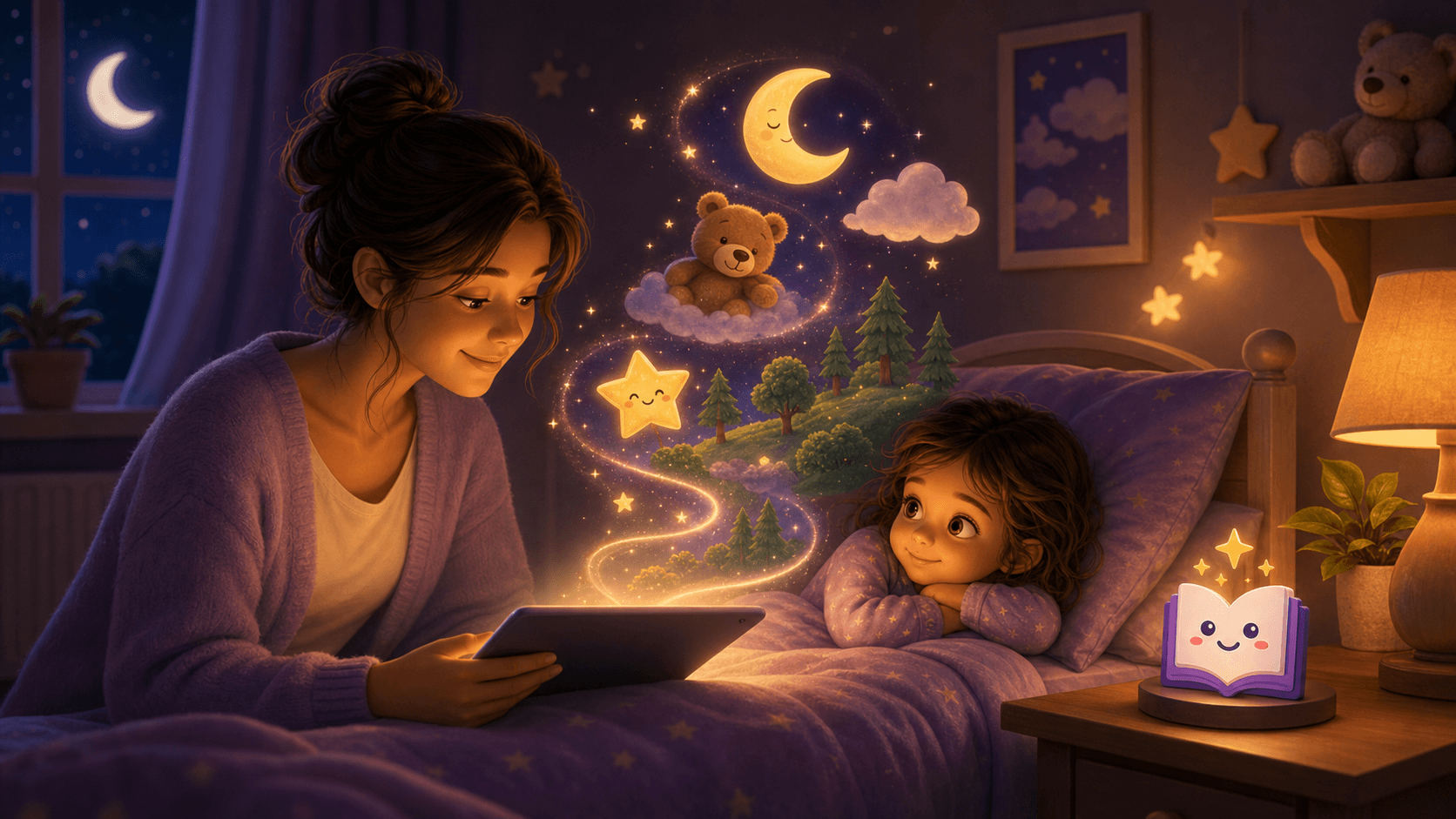
A free bedtime story generator can help parents create a quick personalized story, but it should still be parent-led, age-appropriate, privacy-conscious, and calm enough for sleep. The safest approach is to use simple details, review the story, and avoid turning bedtime into a long prompt-editing session.
Free story tools are tempting for tired parents.
You type a theme, add a child's favorite animal, ask for a cozy ending, and a story appears.
On a good night, that can be exactly what you need.
On a hard night, a free generator can also become one more delay: edit the prompt, regenerate the story, fix the ending, remove a scary scene, try again, and suddenly bedtime is twenty minutes longer.
This guide explains when a free bedtime story generator is useful, where free tools usually fall short, and how to use one safely without losing the calm part of bedtime.
Quick Answer: Should Parents Use a Free Bedtime Story Generator?
Yes, if the parent stays in charge.
A free bedtime story generator works best when you use it before the final sleep routine, keep the story short, and review the output before reading.
Use it for:
- quick story ideas
- gentle personalized drafts
- simple prompts by age or theme
- new versions of a familiar story pattern
- one-off nights when you are too tired to invent a story
Do not use it as an open-ended screen activity at lights out.
The story should serve the routine. The routine should not become about the tool.
What Is a Free Bedtime Story Generator?
A free bedtime story generator is a tool that creates a children's bedtime story from details a parent provides without requiring payment up front.
Some free tools are simple prompt boxes. Others are guided forms that ask for age, name, theme, length, tone, and ending.
The broader category is an AI bedtime story generator: a tool that uses artificial intelligence to create a story draft from a prompt.
For bedtime, the important features are not novelty or speed alone. A good generator needs to produce stories that are:
- short enough for the routine
- calm enough for sleep
- matched to the child's age
- emotionally safe
- easy for a parent to review
- not dependent on sensitive personal details
Free is useful. Safe and calm matter more.
What Free Generators Usually Do Well
Free bedtime story generators are good at giving parents a starting point.
They can help when you know the child wants "a story about a sleepy dinosaur" but your brain is empty.
| Free generator strength | Why it helps |
|---|---|
| Fast first draft | Parents get a story idea quickly |
| Theme flexibility | The story can include animals, space, princesses, dinosaurs, or everyday routines |
| Basic personalization | A name, age, or favorite object can make the story feel more relevant |
| Prompt experimentation | Parents can test story moods and endings |
| Low commitment | Useful before deciding whether a dedicated app is worth it |
This makes free tools especially helpful for occasional use.
They are less reliable when parents need consistent quality every night.
Where Free Bedtime Story Generators Fall Short
Free tools often have weaker guardrails.
That does not mean they are bad. It means parents need to do more of the checking.
Common problems include:
- stories that are too long for bedtime
- language that is too advanced for the child's age
- plots that become too exciting or dramatic
- surprise villains, danger, or cliffhangers
- generic endings that do not feel soothing
- weak privacy explanations
- no saved child preferences
- no consistent story style from night to night
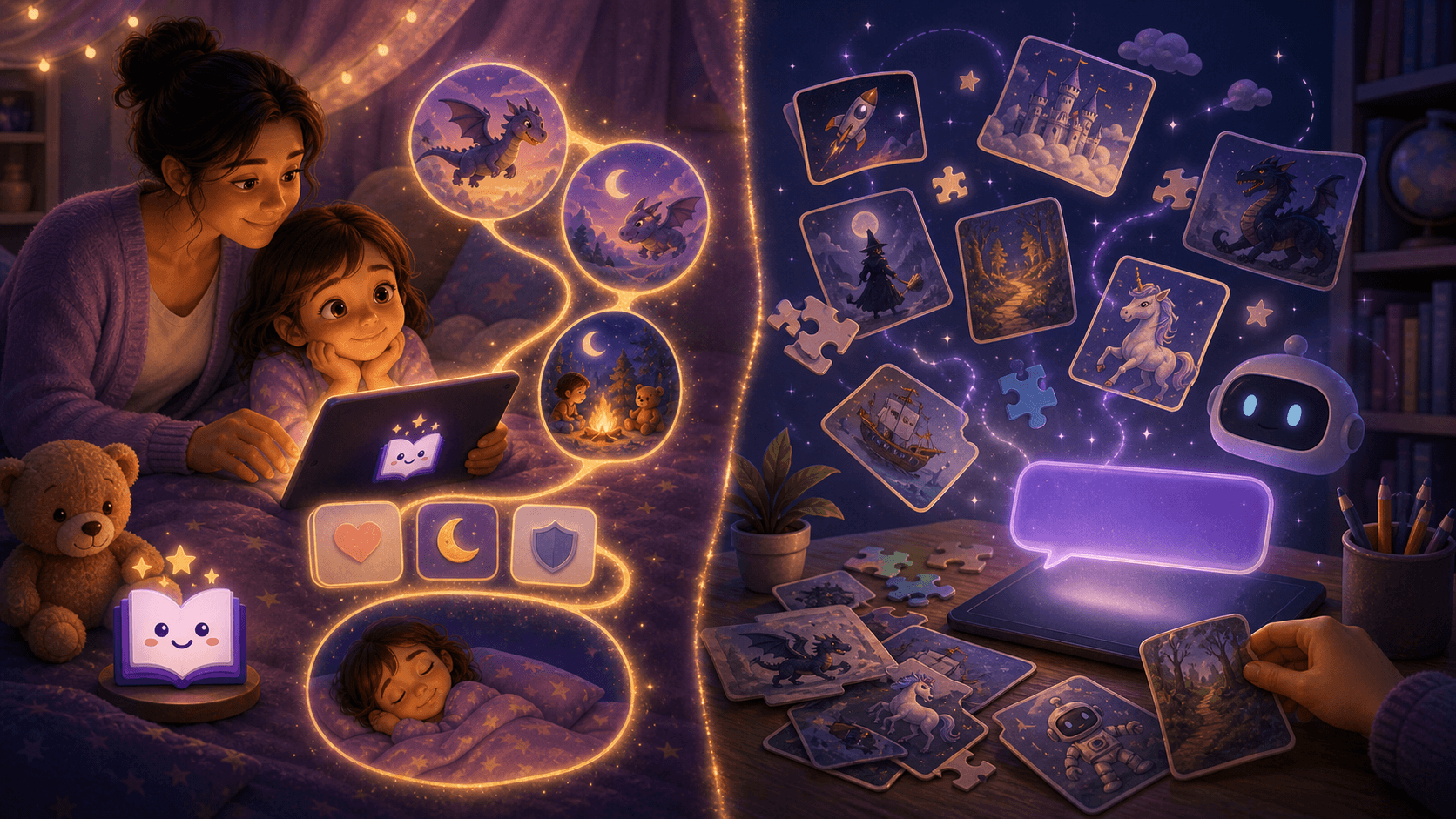
A child-focused bedtime story app vs a generic AI story generator comparison usually comes down to this: free generic tools are flexible, while dedicated apps are built around a narrower family routine.
For bedtime, narrower can be better.
Parent Safety Checklist
Before using any free AI bedtime story tool, check these points.
| Safety question | Better answer |
|---|---|
| Is the tool made for children? | Ideally yes, or the parent must review carefully |
| Does it ask for sensitive details? | It should not need full names, address, school, or private events |
| Can the parent control length and tone? | Yes, especially calm, short, and age-appropriate |
| Does the story avoid scary content? | It should avoid danger, villains, cliffhangers, and intense conflict |
| Is the ending predictable? | Bedtime stories should end with safety, comfort, and rest |
| Is the screen part brief? | The tool should not pull the child into more screen time |
This is the same safety logic covered in Are AI Bedtime Stories Safe for Kids?: AI stories can be safe when the tool is child-focused, the parent reviews the output, and the story stays calm.
What Details Should You Add?
Use low-risk personalization.
Good details:
- age
- first name or nickname
- favorite animal
- favorite theme
- story length
- mood
- bedtime goal
- one simple feeling, such as bravery or calm
Avoid:
- full name
- address
- school name
- exact location
- medical information
- private family conflict
- anything embarrassing or sensitive
You do not need deep personal data to create a good bedtime story.
For example:
Write a calm 5-minute bedtime story for a 4-year-old who loves bears. Use simple language, one gentle problem, no scary scenes, and a cozy ending where the bear feels safe and sleepy.
That is enough.
For more templates, use bedtime story prompts for kids.
Free vs Paid Bedtime Story Generators
The difference is usually not whether one can write a story and the other cannot.
The difference is how much work the parent must do.
| Feature | Free generator | Dedicated bedtime story app |
|---|---|---|
| One quick story | Often good enough | Good |
| Saved child profile | Usually limited | Usually stronger |
| Age-aware structure | Inconsistent | More likely built in |
| Calm bedtime tone | Depends on prompt | More consistent |
| Illustrations | Limited or separate | May be included |
| Audio narration | Limited or separate | May be included |
| Privacy controls | Varies widely | Should be clearer |
| Parent effort | Higher | Lower |
If you only need one idea tonight, free may be enough.
If you want repeatable personalized stories, saved preferences, narration, or illustrations, a dedicated app can be easier.
When a Free Generator Is Enough
A free bedtime story generator is probably enough when:
- you need a single quick story
- your child is not highly anxious at bedtime
- you are comfortable reviewing the output
- the prompt is simple
- the story is read by a parent, not used as independent screen time
- you are testing whether AI stories fit your family
It is also useful for parents who like making up stories but want a starting idea.
You can generate a draft, then warm it up in your own voice.
When a Dedicated App Works Better
A dedicated app works better when you want the story process to be repeatable.
For example, Lulawe is built around personalized bedtime stories for children, not general-purpose writing. That matters when the goal is a calm family routine rather than a clever AI output.
A bedtime story app may work better if you want:
- stories matched to a child's age
- a saved child profile
- recurring preferences
- calmer defaults
- fewer prompt-writing decisions
- illustrated or audio story options
- a smoother routine across many nights
The app should reduce parent effort, not add another task.
Best Prompt for a Free Bedtime Story Generator
Use this simple prompt:
Write a calm bedtime story for a [age]-year-old child who likes [theme]. Make it [length] minutes long. Use simple, age-appropriate language. Include one gentle problem, no scary scenes, no villains, no cliffhanger, and a cozy ending where the character feels safe and sleepy.
Optional additions:
- "Include the nickname [name]."
- "Make the story about feeling brave at bedtime."
- "Use a soft repeated phrase."
- "End with the character getting comfortable in bed."
The best story prompt gives the AI clear boundaries.
The best story goal for bedtime is usually calm, safety, confidence, or sleep.
What to Avoid
Avoid prompts like:
- "Make it exciting."
- "Add a big adventure."
- "Surprise my child."
- "Make it funny and wild."
- "Use lots of twists."
- "End with a cliffhanger."
Those can be fun earlier in the day.
They are usually poor bedtime instructions.
Also avoid regenerating over and over while your child waits. That teaches bedtime to become negotiable and screen-centered.
Pick a story, read it warmly, and end the routine.
Final Takeaway
A free bedtime story generator can be a useful tool for parents.
It is best for quick ideas, simple personalization, and nights when you need help starting a story.
But free should not mean careless.
Use low-risk details, ask for a calm ending, review the story, and keep the parent in control.
The goal is not to make bedtime more digital.
The goal is to make the final story easier, warmer, and calmer.