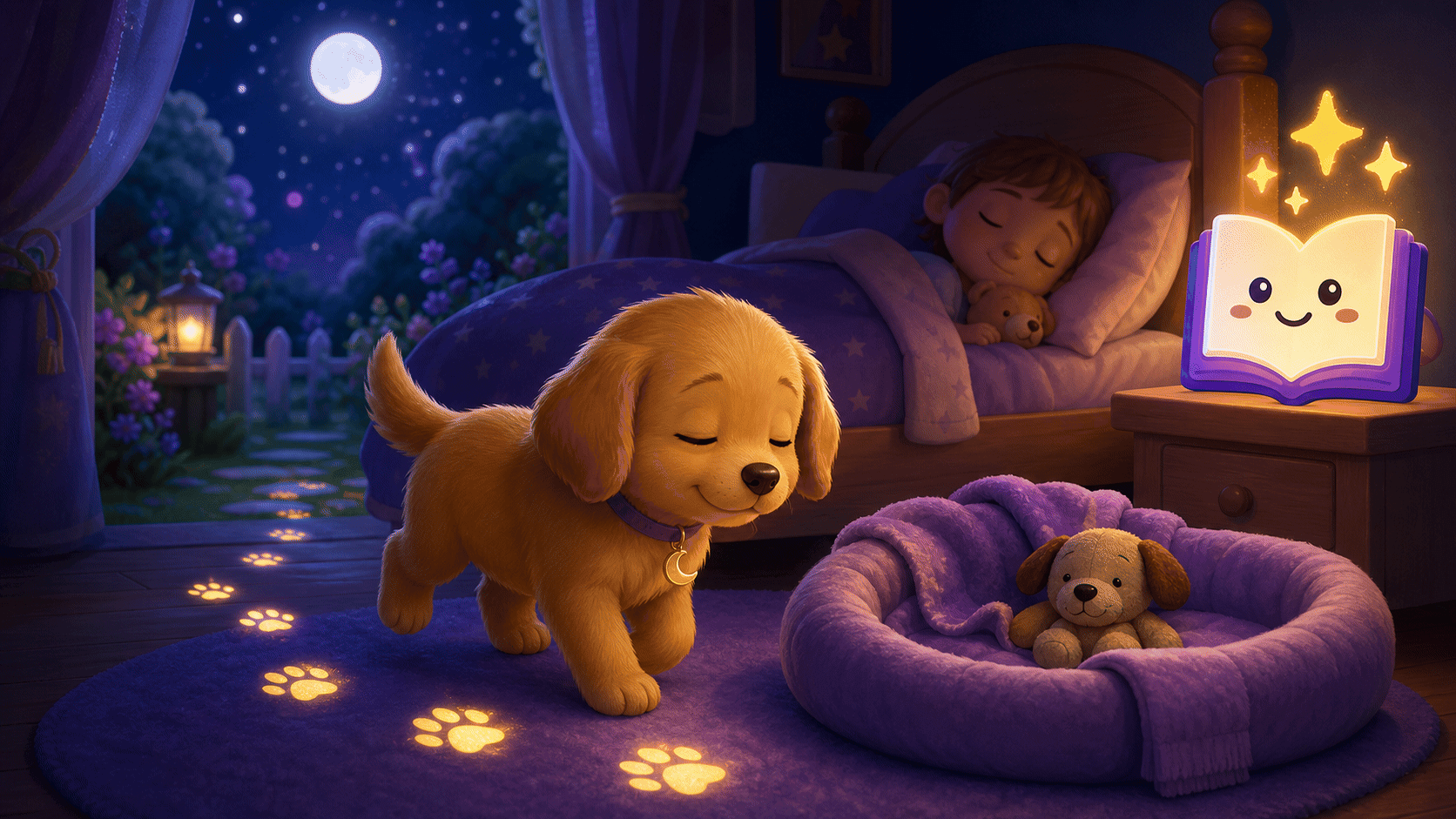
A puppy bedtime story should turn a playful animal into a gentle guide toward sleep. This complete 8-minute story is written for children aged 2–6 and uses a repeated goodnight phrase, a familiar routine, and a safe ending in a warm dog bed.
At a glance:
- Story: Pip and the Last Goodnight
- Age: 2–6 years
- Reading time: about 8 minutes
- Mood: cozy, affectionate, sleepy
- Theme: finishing the day and settling into a routine
In this article:
- Pip and the Last Goodnight
- Why Puppy Stories Work at Bedtime
- Adapt the Story by Age
- Make Up Your Own Puppy Story
- Personalize Pip's Story
- Choose Another Bedtime Story
Pip and the Last Goodnight
A short puppy bedtime story for ages 2–6, reading time approximately 8 minutes.
Pip was a small golden puppy with soft ears, four white paws, and a purple collar that jingled when he walked.
He lived in a quiet house with a child named Robin. Pip's round bed sat beside Robin's bed, tucked beneath a shelf of picture books. His blue blanket smelled like clean laundry, and his stuffed dog waited in the middle of the cushion every night.
Pip liked his bed.
He simply was not ready to get into it.
Robin had put on pajamas, brushed every tooth, and chosen a story. The lamp was low. The curtains were closed. Even the clock seemed to be ticking more softly.
But Pip stood in the hallway with his tail making one hopeful wag.
“Have you forgotten something?” Robin asked.
Pip looked at his water bowl. It was full.
He looked at his toy basket. The ball, rope, and squeaky carrot were all inside.
He looked at the back door. It was locked, and the moon shone through its little window.
Pip gave a tiny huff. Something still felt unfinished.
Robin knelt beside him. “Perhaps you need to say goodnight to the day.”
Pip tilted his head.
Together, they began with the kitchen.
The silver water bowl reflected Pip's nose. He took one last drink, then Robin whispered, “Goodnight, water bowl. Your work is done.”
Pip's tail became still.
They passed the toy basket next. Pip sniffed the squeaky carrot but did not take it out.
“Goodnight, toys,” Robin said. “Your work is done.”
Pip sat down for one quiet second.
At the back door, moonlight made a pale square on the floor. Outside, the garden path rested between dark flowers. A moth folded its wings beneath the porch light.
“Goodnight, garden,” Robin whispered. “Your work is done.”
Pip's ears relaxed.
They walked through the sitting room. The sofa cushions had been straightened. A book lay closed on the table. Pip's favorite patch of rug was empty and warm.
“Goodnight, sitting room. Your work is done.”
Pip yawned.
It was not a large yawn. It began at the tip of his nose, opened his little mouth, and ended with a soft puff.
Robin smiled but did not say anything. They kept walking slowly.
On the stairs, Pip usually hurried ahead. Tonight he climbed beside Robin: one step, then another, then another.
Jingle went his collar.
Step went his paws.
Slow went the house.
At the top, they passed the bathroom. Pip's brush waited beside a folded towel.
“Goodnight, brush. Your work is done.”
Pip's second yawn was bigger.
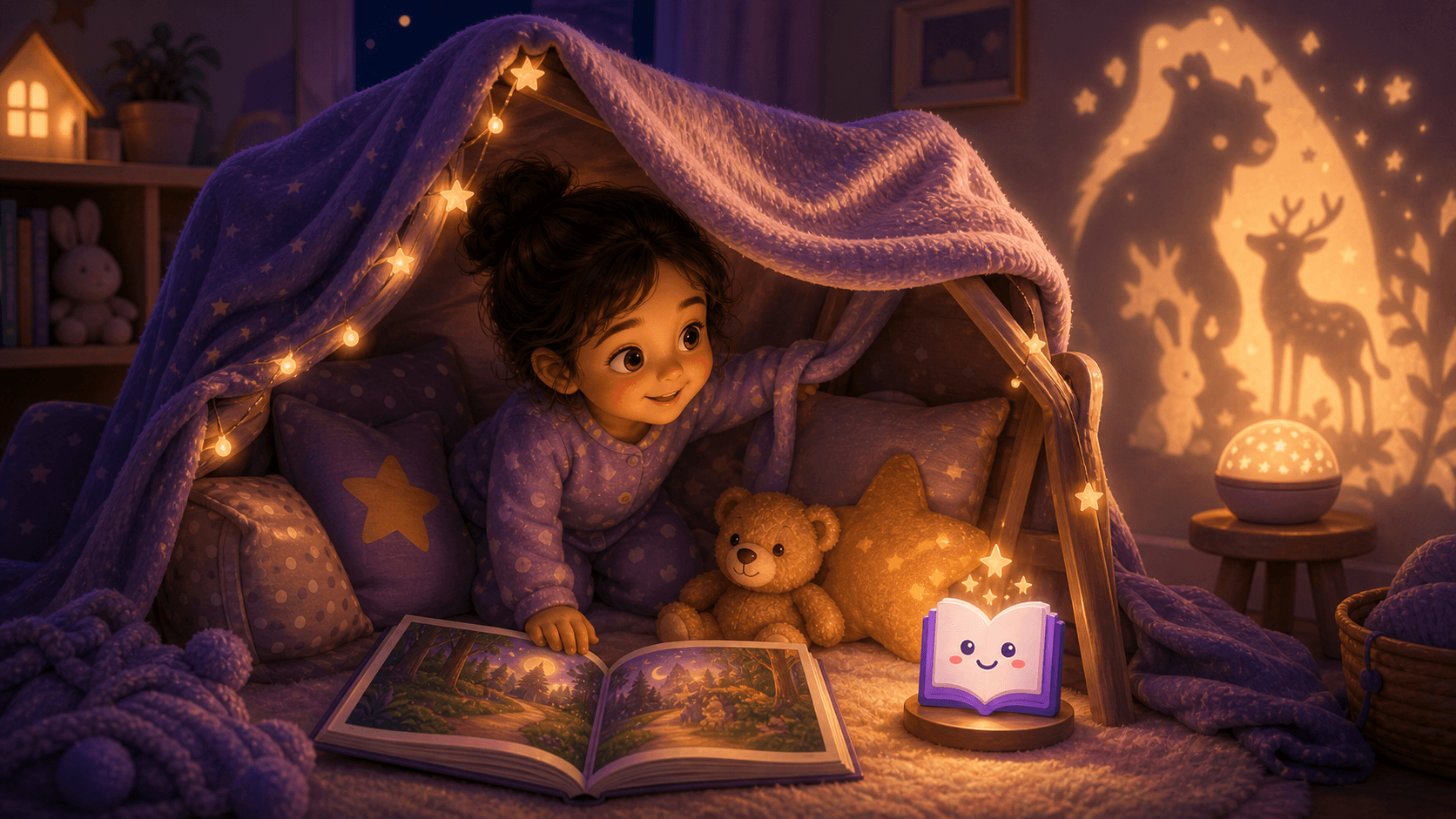
When they reached the bedroom, Robin tucked the blanket around the pillow and placed the chosen story on the bedside table. The glowing purple storybook nightlight made three golden stars shine on the wall.
Pip looked at his round bed.
His stuffed dog was waiting exactly where he had left it.
His blue blanket had one corner turned down.
The room was quiet enough to hear Robin breathe in and breathe out.
Pip circled his bed once.
He circled it twice.
On the third circle, he stopped.
Robin touched the cushion. “Goodnight, Pip. Your work is done.”
That was the goodnight Pip had been looking for.
He had watched the garden, played with the toys, followed Robin through the house, and filled every room with little pawprints. Nothing else needed fetching. Nothing else needed checking. Morning would bring water, toys, garden paths, and games again.
Pip stepped into his bed.
He tucked his nose beside the stuffed dog's ear. Robin drew the blue blanket over his back, leaving his four white paws underneath.
“Water bowl?” Robin whispered.
Pip closed one eye.
“Goodnight. Your work is done.”
“Toys?”
Pip closed the other eye.
“Goodnight. Your work is done.”
“Garden?”
Pip breathed in.
“Goodnight. Your work is done.”
“Puppy?”
Pip breathed out.
His collar did not jingle. His tail did not wag. His soft ears rested against the cushion.
The purple book light glowed beside Robin. Three golden stars stayed on the wall while the house became completely still.
Pip had said every goodnight he needed.
And his day's work was done.
Why Puppy Stories Work at Bedtime
Puppies bring familiar emotions into a simple shape: they can be playful, curious, affectionate, and reluctant to stop. A child does not need to own a dog to recognize Pip's feeling that one more thing might need doing before bed.
The repeated line — “Goodnight. Your work is done.” — gives the story a predictable pattern and clear closure. Each stop becomes quieter, so the structure itself moves from activity toward rest.
The American Academy of Pediatrics encourages families to read aloud with children. A short shared story can fit naturally inside a consistent bedtime routine, especially when the ending is predictable and the reader allows a few unhurried pauses.
Adapt the Story by Age
Ages 2–3
Use only the water bowl, toys, and puppy bed. Invite your child to repeat “your work is done” in a whisper. Keep the story close to 5 minutes.
Ages 4–5
Read the complete story and let your child choose the stuffed dog's name before you begin. Keep questions out of the final bedroom scene.
Age 6
Ask your child to choose one additional ordinary object Pip can say goodnight to, such as a raincoat or pair of shoes. Add it before Pip goes upstairs so the ending stays unchanged.
Make Up Your Own Puppy Story
Use this five-part puppy story pattern:
- Give the puppy one familiar home and sleeping place.
- Choose one small bedtime problem.
- Repeat one calming phrase three or more times.
- Make each scene quieter than the previous one.
- End with the puppy safe, warm, and asleep.
For another easy structure, use these bedtime story prompts for kids or learn how to make up a bedtime story.
Personalize Pip's Story
Change Pip's name, coat color, collar, favorite toy, and sleeping place. If your child has a stuffed dog, use its name and appearance. A familiar hallway, garden gate, or picture-book shelf can make the setting feel personal without making the plot more complicated.
Create a personalized puppy story starring your child with Lulawe. You can also try our gentle bunny bedtime story or find an age-matched option in the best bedtime stories for kids by age.
Choose Another Bedtime Story
Pick tomorrow night's gentle adventure:
- Bunny bedtime story
- Ocean bedtime story
- Mermaid bedtime story
- Fairy bedtime story
- Unicorn bedtime story
Or browse more bedtime story ideas for kids.