A dinosaur bedtime story works best when the dinosaur is friendly rather than fearsome, faces a small challenge that resolves by the end, and settles into sleep — giving your child a character to follow into rest. The dinosaur story is one of the most effective formats for children who resist bedtime: it meets them in their world, then walks them gently out of it.
Below you will find a complete short dinosaur bedtime story you can read tonight, plus tips for telling it by age and making it personal for your child.
In this article:
- The Little Dinosaur Who Didn't Want to Sleep — ready-to-read story (~10 min)
- Why Dinosaur Stories Work at Bedtime
- Adapting by Age — toddlers through age 6
- Tips for Parents
- Make Up Your Own
- Personalized Dinosaur Stories
- Choose Another Bedtime Story
The Little Dinosaur Who Didn't Want to Sleep
A short dinosaur bedtime story — suitable for ages 2–6, reading time approximately 10 minutes.
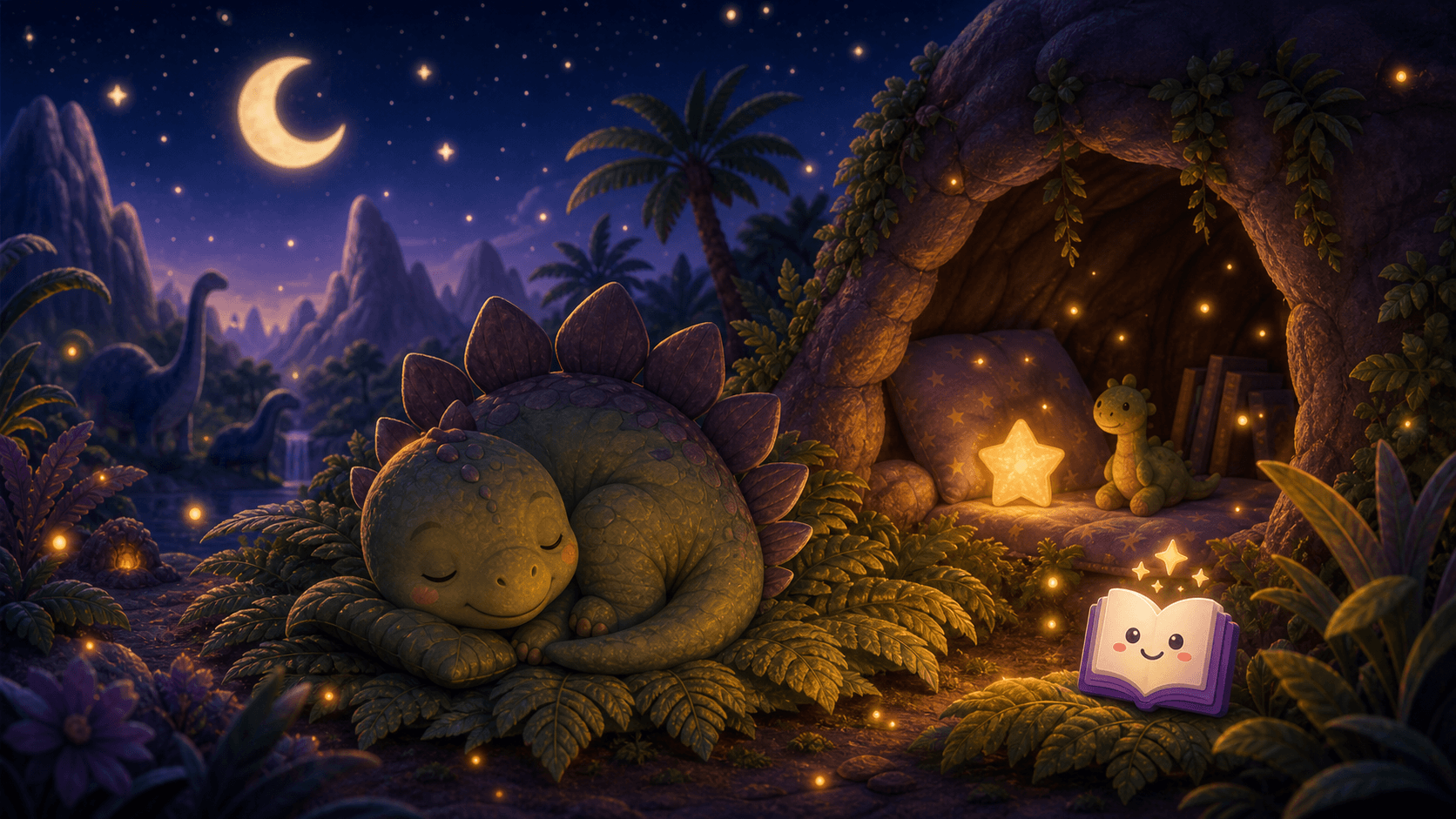
Deep in a valley where the ferns grew tall and the river moved slowly, there lived a small green dinosaur named Pip.
Pip was a stegosaurus — which meant he had a round, gentle face, four sturdy legs, and a row of small orange plates along his back that turned slightly gold in the evening light.
Every night, when the sky began to turn purple, the other dinosaurs in the valley would yawn their great wide yawns and settle into their sleeping spots — the triceratops under the ancient tree, the brachiosaurus beside the river, the ankylosaurs tucked into the tall ferns like sleeping boulders.
But Pip did not want to sleep.
"What if something happens?" he asked his mother, who was already half-asleep with her chin resting on a mossy rock.
"Something like what?"
Pip thought. "Something good. Something I'll miss."
His mother opened one eye. "Like what happened yesterday?"
Yesterday, Pip had stayed awake to see if anything happened, and had fallen asleep anyway standing up, and had woken up with a fern stuck to his face.
"That was different," said Pip.
His mother closed her eye again. "Try," she said. "Just try."
Pip walked to the edge of the sleeping hollow and looked out at the valley.
The sky was deep purple now. The first stars were coming out, one by one, as if they were shy and checking to see if anyone was watching before they appeared.
A small river fish jumped and made a quiet plop.
A moth flew past Pip's nose so slowly it was almost not flying.
Pip breathed in. The air smelled like warm mud and something sweet he had never been able to name.
He breathed out.
He looked at the stars. There were more of them now — lots more, too many to count, spread across the sky like someone had shaken silver dust from a very great height.
It was, Pip thought, rather beautiful.
It was also, he noticed, making him feel quite heavy.
Not a bad heavy. A warm heavy. The kind of heavy that meant all the day's running and eating and wondering was finally settling, like the river settling after a stone has been thrown in.
He walked back to his sleeping spot — a curved hollow between two warm boulders, padded with dry ferns that crinkled quietly when he stepped on them.
He turned around three times the way dinosaurs do.
He lay down.
The stars were still there, visible through the opening in the ferns.
Nothing had happened while he was looking. Or maybe, Pip thought slowly, the looking was the thing that happened.
He closed his eyes.
The valley breathed around him — the river, the frogs, the slow wind through the ancient ferns.
And Pip, who had not wanted to sleep, was asleep before he knew it had begun.
Why Dinosaur Stories Work at Bedtime
The dinosaur setting does something useful for bedtime stories: it is exotic enough to fully absorb a child's attention, but distant enough from the real world to feel safe. The prehistoric valley has no school, no worries, no tomorrow. It is just a world going to sleep.
Pip's story also directly addresses one of the most common reasons children resist bedtime: FOMO — the feeling that something interesting will happen while they are asleep. The story validates that feeling, then resolves it gently. Nothing missed. The looking was the thing.
For children who use "but what if something happens?" as a bedtime delay, this story offers an answer they can feel rather than just hear.
Adapting This Story by Age
| Child's age | Story length | Key focus |
|---|---|---|
| Toddler (2–3) | 5–8 min | Simplify to: Pip, stars, heavy, sleep |
| Ages 4–5 | 10–15 min | Full story, breathe with Pip at the end |
| Ages 5–6 | 15–20 min | Add a dinosaur friend to the story |
For toddlers (ages 2–3)
Simplify as you go. Reduce to: Pip doesn't want to sleep, Pip looks at the stars, Pip gets sleepy, Pip goes to sleep. Use shorter sentences and slower pacing toward the end. The repetitive rhythm of "he breathed in, he breathed out" can be done with your toddler — make it physical by breathing together.
For children aged 4–5
Read the full story. Children this age love the specific dinosaur detail — the orange plates on his back, the stars appearing one by one, the fern hollow. Slow down during the final section (from "Pip breathed in" onward) and let the pace of the sentences carry the mood. Ask before reading: "Which dinosaur do you want to be in the story tonight?"
For children aged 5–6
Add layers. You can give Pip a friend — another dinosaur who is also awake and doesn't want to sleep — and have them help each other settle. Children this age enjoy stories that mirror their social world, and a friendship element gives the story emotional texture beyond just the bedtime theme.
Dinosaur Story Tips for Parents
Use dinosaur sounds strategically. A distant roar or a deep thump of footsteps works well in the middle of the story — it captures attention and signals something is happening. But avoid high-energy sounds in the final third. The sounds should become softer, slower, further away as the story nears its end.
Match your voice to the mood. When Pip is awake and restless, read with slightly more energy. As the valley settles and Pip gets heavy, let your own voice slow, deepen, and quiet. Children physically respond to the pacing and volume of a parent's reading voice — you are not just telling a story, you are regulating their nervous system with your voice.
End on stillness. Whatever variations you make, end with the dinosaur asleep. This gives your child a clear model to follow. The story's ending is an invitation.
How to Make Up Your Own Dinosaur Bedtime Story
If your child has heard this story before and wants something new, you can create a fresh dinosaur story any night using this simple structure:
- Choose a dinosaur. Let your child pick. Knowing the species name is a bonus — "a green parasaurolophus named..." — but any dinosaur works.
- Give it a small problem. It cannot find its cosy spot. It heard a sound it cannot identify. Its friend is in a different part of the valley tonight.
- Send it to explore. Two or three gentle discoveries — a firefly, a warm rock, a kind older dinosaur who shows it something.
- It finds its place and settles. Simple, complete, at peace.
The structure takes about 8 minutes when told slowly and can be reinvented every night with a different dinosaur name and problem.
Personalized Dinosaur Bedtime Stories
The most engaging dinosaur story for your child is one where they are the dinosaur — or where a dinosaur named for them goes on a small adventure perfectly calibrated to their interests and current life.
A personalized bedtime story with a dinosaur character works best when it:
- Names the dinosaur after your child (or lets them choose the name and species)
- Sets the story in a version of a place they love — their garden turned prehistoric, their bedroom turned into a cave
- Reflects something they are genuinely interested in — if they know ten dinosaur species, include some of them
- Ends with the dinosaur in a situation that mirrors the child at bedtime: warm, safe, and ready to sleep
Lulawe generates personalized bedtime stories built around your child's name, age, and chosen themes. Choose "dinosaur" as the theme, add a few details about your child, and the app creates a story that is specifically theirs — ready to read in a few minutes, different each time if you want it to be.
What to Read Next
For dinosaur-loving children who are ready for more, these work well at bedtime:
- Harry and the Dinosaurs series by Ian Whybrow — picture books; warm, funny, Harry and his dinosaur box are a favourite for ages 3–5
- How Do Dinosaurs Say Goodnight? by Jane Yolen — picture book; directly addresses bedtime resistance through a dinosaur lens; excellent for ages 2–4
- The Dinosaur That Pooped a Planet series by Tom Fletcher — for ages 4–6; very funny, short chapters, good for reluctant bedtime settlers
- My Father's Dragon by Ruth Stiles Gannett — no dinosaurs, but has a dragon and a vivid creature-filled world; ideal for ages 5+ who want longer stories
For a story where your child is the dinosaur, try Lulawe. For more themed story ideas, see our princess bedtime story or unicorn bedtime story. For age-specific recommendations across all themes, see the best bedtime stories for kids by age.
Choose Another Bedtime Story
Pick tomorrow night's gentle adventure:
- Space bedtime story
- Robot bedtime story
- Pirate bedtime story
- Puppy bedtime story
- Bunny bedtime story
Or browse more bedtime story ideas for kids.