A unicorn bedtime story works best when it features calm, luminous magic, a gentle challenge gently resolved, and an ending that leaves your child with a feeling of wonder rather than excitement. The unicorn story is one of the most naturally sleep-friendly themes in children's storytelling — magical enough to capture the imagination, soft enough not to raise it.
Below you will find a complete short unicorn bedtime story you can read tonight, followed by tips for adapting it to your child's age and making it personal.
In this article:
- The Unicorn Who Lost Her Sparkle — ready-to-read story (~10 min)
- Why Unicorn Stories Work at Bedtime
- Adapting by Age — toddlers through age 7
- Telling Without a Book
- Personalized Unicorn Stories
- Choose Another Bedtime Story
The Unicorn Who Lost Her Sparkle
A short unicorn bedtime story — suitable for ages 3–7, reading time approximately 10 minutes.
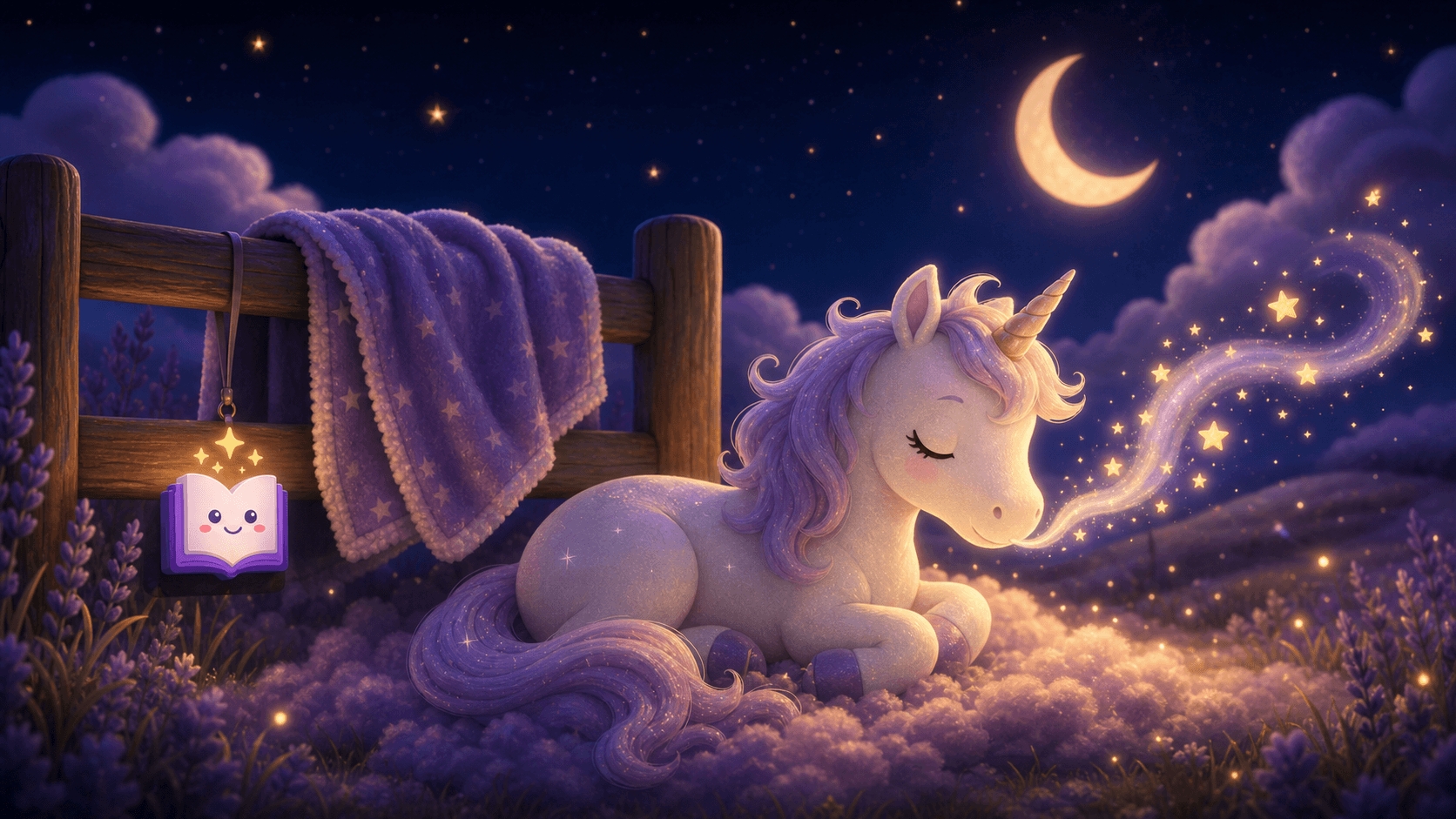
Once, in a meadow at the edge of a great forest, there lived a unicorn named Lumi.
Lumi's horn usually shone like the inside of a shell — soft, pearly, and faintly silver. When she walked through the meadow at evening, the flowers turned toward her as if she were a gentle kind of sun.
But one night, Lumi looked at her reflection in the pond — and her horn was dark.
No glow. No shimmer. No sparkle at all.
She did not panic. She thought carefully, the way careful creatures do.
Where had the sparkle gone?
She walked to the oldest oak tree in the forest and asked the bark beetles, who knew everything about what happened in the dark.
"Did you see a sparkle go by?" she asked.
"We saw something silver drift past at dusk," said the oldest beetle. "It floated toward the hill where the starflowers grow."
Lumi walked to the hill.
The starflowers were closed for the night, their petals folded tight. But between two of them, caught like a small bright fish in a net, was a tiny cloud of silver light — her sparkle, tangled in the stems.
She leaned close. The sparkle drifted toward her horn.
But it did not re-attach.
Lumi sat very still on the hill and thought about this.
Why won't it come back?
She thought about the day she had just had. She had run a very long way. She had eaten quickly. She had been so busy doing that she had forgotten to simply be.
She breathed in, slowly.
She breathed out.
The night air smelled of cool grass and distant rain.
She breathed in again.
And this time, when she breathed out — the sparkle rose from the starflowers and settled back onto her horn, softly, like a moth landing.
Her reflection in the distant pond shimmered silver again.
Lumi did not get up right away. She sat on the hill for a little while longer, breathing slowly, watching the stars come out one by one — each one waking up in its own time, at its own pace.
Then she walked back through the meadow to her soft place under the willow tree.
She lay down.
She breathed in.
She breathed out.
And all the flowers in the meadow, and all the fireflies, and all the stars that had just woken up — they all shone a little brighter, just for a moment, as Lumi closed her eyes.
Why Unicorn Stories Work at Bedtime
Unicorn bedtime stories draw children in for the same reason that candles and snow globes do — they offer a small, enclosed, luminous world that is entirely safe.
Research by psychologist Elaine Hatfield on emotional contagion shows that humans — including young children — synchronise their physiological state to the pace and tone of communication they receive. A story told slowly, in a calm voice, about a creature who breathes and settles, actively regulates your child's nervous system as they listen. The American Academy of Pediatrics recommends daily read-aloud time from birth for exactly this reason — the benefits go well beyond vocabulary. The best bedtime stories work not by exciting the imagination but by giving it something beautiful and complete to rest in.
The story above carries a second layer that older children will absorb without realising: the sparkle returns when Lumi stops rushing and starts breathing. This is not an accident. Stories that model slow breathing and stillness can help children regulate their own nervous systems as they listen.
This is part of what makes calming bedtime stories effective — they do not just distract the mind from the day; they actively guide it toward the conditions that support sleep.
Adapting This Story by Age
| Child's age | Story length | Key focus |
|---|---|---|
| Toddler (2–3) | 5–8 min | Simple language, breathe together |
| Ages 4–5 | 10–15 min | Full story, sensory detail, slow pace |
| Ages 6–7 | 15–20 min | Add emotional depth, second character |
For toddlers (ages 2–3)
Shorten to the core: Lumi loses her sparkle, finds it on a hill, breathes slowly, and it comes back. Use very simple language and slow your voice as the story nears the end. The breathing element — breathe in, breathe out — can be done together with your child, which makes it a gentle sleep technique as well as a story.
For children aged 4–6
Read the full story with descriptive detail. Children this age love the sensory world of the story — the closed starflowers, the smell of cool grass, the reflection in the pond. Slow down at the breathing moment and make it slightly theatrical. Ask your child to breathe with Lumi.
For children aged 6–7
Add emotional depth. Before Lumi finds her sparkle, she might try one or two things that do not work — rushing back to the meadow, shaking her horn, asking loudly. The lesson that stillness works where rushing fails lands well at this age. You can also give the bark beetles more personality or add a second character.
How to Tell a Unicorn Story Without a Book
A unicorn story told from memory follows the same simple structure:
- Who is the unicorn? Name her (ideally your child's name, or a name your child picks), give her one quality, place her in a soft magical setting.
- What small thing is wrong? Something gentle is off — a missing sparkle, a lost friend, a sound she cannot identify.
- What does she do? She goes to find the answer, asks a wise creature, or discovers it through stillness.
- How does it end? The problem resolves gently. The unicorn finds her place. She rests.
The key to unicorn story pacing: slow the sentences as the story moves toward its ending. Short sentences. Pauses between them. The rhythm of the storytelling should match the rhythm of falling asleep.
Personalized Unicorn Bedtime Stories
The unicorn story has particular power when your child is the unicorn — or when they are the unicorn's closest companion, the one who helps her find her sparkle again.
A personalized bedtime story with a unicorn character works best when it:
- Uses your child's name or a name they choose for the unicorn
- Incorporates one or two specific real details — the colour of the unicorn's mane matches their favourite colour, the meadow looks like a park they know
- Reflects something they are actually working through — a day that felt too busy, a situation where they felt unseen, a moment of worry that resolved
- Ends with both the unicorn and your child settling toward sleep
Lulawe creates personalized bedtime stories built around your child's name, interests, and chosen themes — including magical creatures like unicorns. You choose the theme and a few details about your child, and the app generates a story that is specifically theirs, ready to read in minutes.
What to Read Next
For children who love unicorn stories, these chapter books work well at bedtime:
- The Last Unicorn by Peter S. Beagle — for older children (ages 8+); beautiful, melancholy, and literary
- Uni the Unicorn by Amy Krouse Rosenthal — picture book; warm, simple, ideal for ages 3–5
- A Unicorn Named Sparkle by Amy Young — early reader; funny and sweet, ideal for ages 4–6
For a story where your child is the unicorn, try Lulawe. For more themed stories, see our princess bedtime story or dinosaur bedtime story. For full by-age recommendations, see the best bedtime stories for kids by age.
Choose Another Bedtime Story
Pick tomorrow night's gentle adventure:
- Princess bedtime story
- Dragon bedtime story
- Friendly monster bedtime story
- Superhero bedtime story
- Dinosaur bedtime story
Or browse more bedtime story ideas for kids.