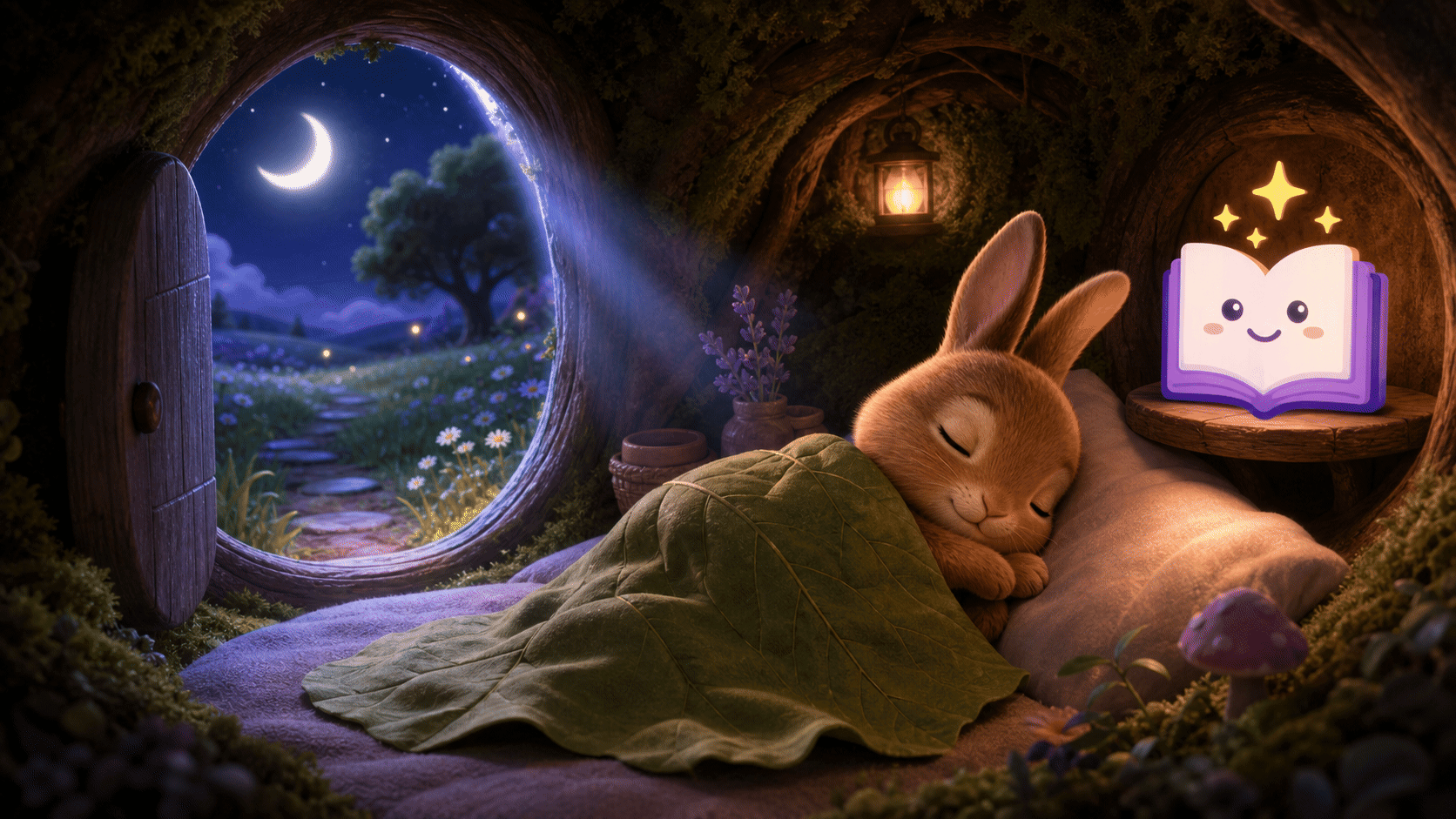
A bunny bedtime story works best when the rabbit is small, kind, and safely home before the last line. This complete story takes about 8 minutes to read and is designed for children aged 2–6, with repeated goodnight phrases and a quiet ending.
At a glance:
- Story: The Bunny Who Followed the Moonbeam
- Age: 2–6 years
- Reading time: about 8 minutes
- Mood: gentle, reassuring, sleepy
- Theme: asking for help and finding the way home
In this article:
- The Bunny Who Followed the Moonbeam
- Why Bunny Stories Work at Bedtime
- How to Adapt the Story by Age
- Make Up Your Own Bunny Story
- Personalize Tonight's Story
- Choose Another Bedtime Story
The Bunny Who Followed the Moonbeam
A short bunny bedtime story for ages 2–6, reading time approximately 8 minutes.
At the edge of a quiet meadow lived a little brown bunny named Clover.
Clover's burrow was tucked beneath an old apple tree. It had a round green door, a mat made of moss, and a tiny window that showed exactly one star.
Every evening, Clover helped Mama Bunny prepare for bed. They shook the dust from their paws, folded a soft leaf blanket, and said goodnight to the familiar sounds outside.
“Goodnight, crickets,” Mama Bunny would say.
“Goodnight, grass,” Clover would whisper.
“Goodnight, moon.”
One evening, Clover noticed a silver moonbeam lying across the meadow like a ribbon.
“Where does it go?” she wondered.
Mama Bunny was filling their cups with warm clover tea. “Only a little way,” she said. “Stay where you can see the apple tree.”
Clover promised. She hopped once, twice, three times along the silver light.
The moonbeam crossed a patch of daisies. Clover stopped to say goodnight to each white flower. Then it slipped around a smooth grey stone, and Clover followed.
On the other side, she met a sleepy snail carrying his house.
“Good evening,” said Clover. “Do you know where the moonbeam goes?”
“Everywhere the moon can see,” the snail replied slowly. “But I am going home.”
Clover looked back. The apple tree was hidden behind the tall grass.
Her ears stood straight up.
For one small moment, Clover wanted to hop very fast. Then she remembered what Mama Bunny did whenever something felt too big.
She put one paw on her tummy.
In through the nose.
Out through the mouth.
The grass moved softly. The daisies nodded. Nothing was chasing her. Nothing was wrong. Clover simply needed help finding the path she already knew.
“I think I have hopped too far,” she told the snail.
“Then we will listen for home,” he said.
They became very still.
Clover heard the crickets first: chirp, chirp, chirp.
Then she heard apple leaves brushing together: hush, hush, hush.
And far away, she heard Mama Bunny calling, “Clover?”
“Here I am!” Clover called.
A warm lantern appeared between the stems of grass. Mama Bunny followed its glow, and soon her soft grey ears rose above the daisies.
Clover hopped into her arms.
“I followed the moonbeam,” Clover explained. “Then I stopped, breathed, listened, and asked for help.”
Mama Bunny held her close. “That was a very brave way to come home.”
Together they thanked the snail and followed the lantern back. The moonbeam came too, slipping beside them all the way to the round green door.
Inside, Clover tucked her paws under the leaf blanket. Mama Bunny folded one corner over Clover's feet and another over her shoulders.
“Goodnight, crickets,” Mama Bunny whispered.
“Goodnight, grass,” Clover murmured.
“Goodnight, moonbeam. Thank you for coming home with me.”
The one star in the window blinked.
Clover's ears relaxed onto the pillow. Her breathing became slow and soft.
And beneath the old apple tree, the little burrow grew quiet until morning.
Why Bunny Stories Work at Bedtime
Bunnies naturally fit a calm bedtime story: they have soft homes, quiet movements, close families, and long ears that can listen for reassuring sounds. A small rabbit can feel unsure without the story becoming frightening.
This story also gives children a simple four-step pattern they can remember: stop, breathe, listen, ask for help. It is a storytelling tool, not a promise that every real situation can be solved alone; young children should still stay close to a trusted adult.
The American Academy of Pediatrics encourages parents to read aloud with children. At bedtime, the most useful story is often the one a parent can read slowly, finish predictably, and enjoy with the child.
How to Adapt the Story by Age
Ages 2–3
Shorten the meadow journey and repeat “goodnight, crickets; goodnight, grass; goodnight, moon” together. Keep the story near 5 minutes.
Ages 4–5
Read the full story and ask one question before starting: “What sound helps Clover find home?” Avoid interrupting the quiet ending with more questions.
Age 6
Invite your child to choose one extra sound Clover hears, such as an owl, a gate, or rain on leaves. Keep the same safe ending.
Make Up Your Own Bunny Story
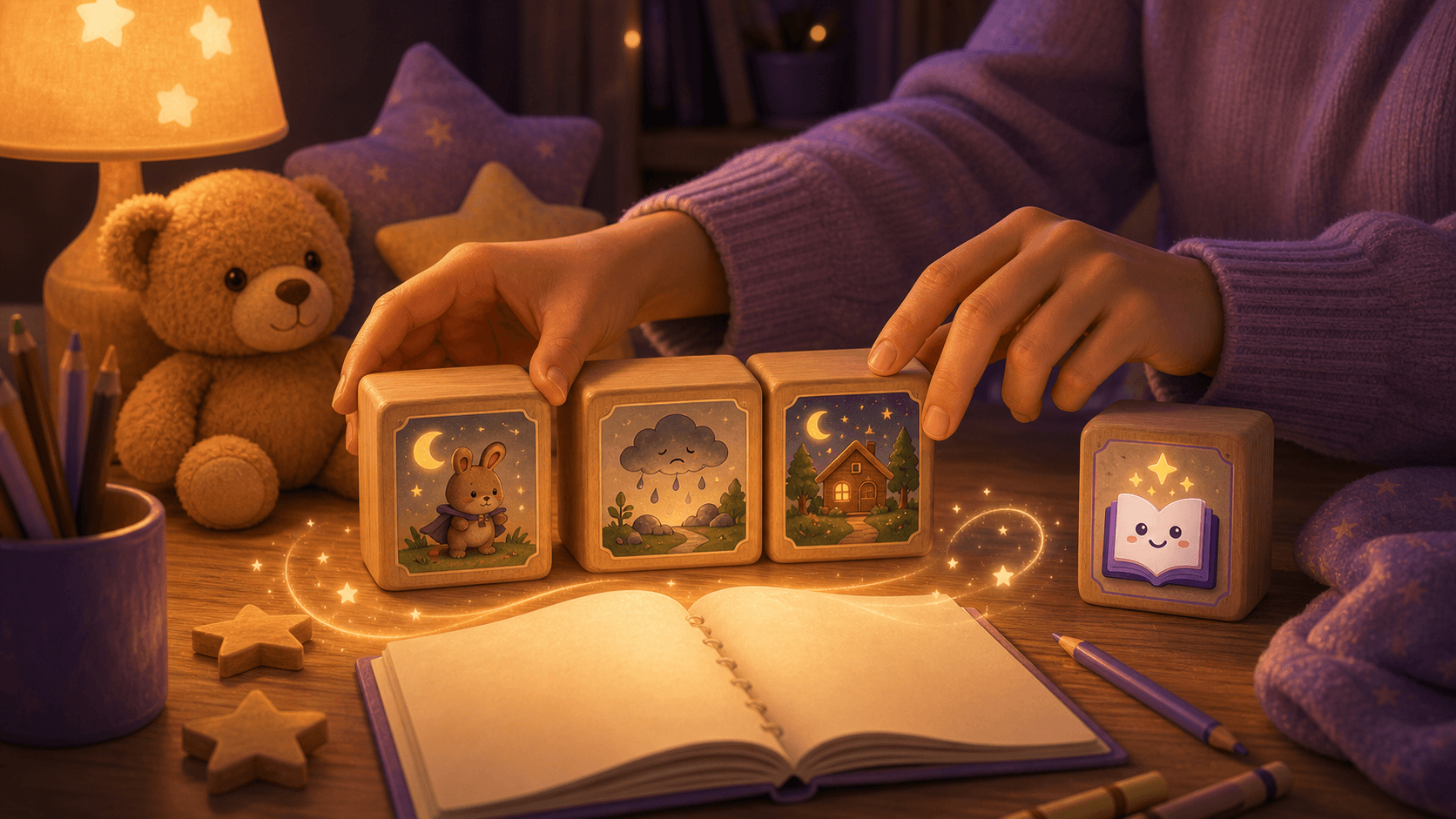
Use this five-part bunny story recipe:
- Choose a cozy home: a burrow, garden shed, or hollow tree.
- Give the bunny one small goal.
- Add one gentle obstacle, such as fog or a misplaced blanket.
- Let the bunny solve it with patience, kindness, or help.
- End with the bunny warm, safe, and asleep.
For more ideas, use these bedtime story prompts for kids or learn how to make up a bedtime story.
Personalize Tonight's Story
Replace Clover's name, fur color, favorite drink, and familiar landmark. A child who loves yellow can follow a golden moonbeam; a child with a toy bear can meet that bear beside the daisies.
For a story built around your child's own choices, create a personalized bedtime story with Lulawe. You can also read our friendly monster bedtime story or choose a story from the best bedtime stories for kids by age.
Choose Another Bedtime Story
Pick tomorrow night's gentle adventure:
- Ocean bedtime story
- Mermaid bedtime story
- Fairy bedtime story
- Unicorn bedtime story
- Princess bedtime story
Or browse more bedtime story ideas for kids.