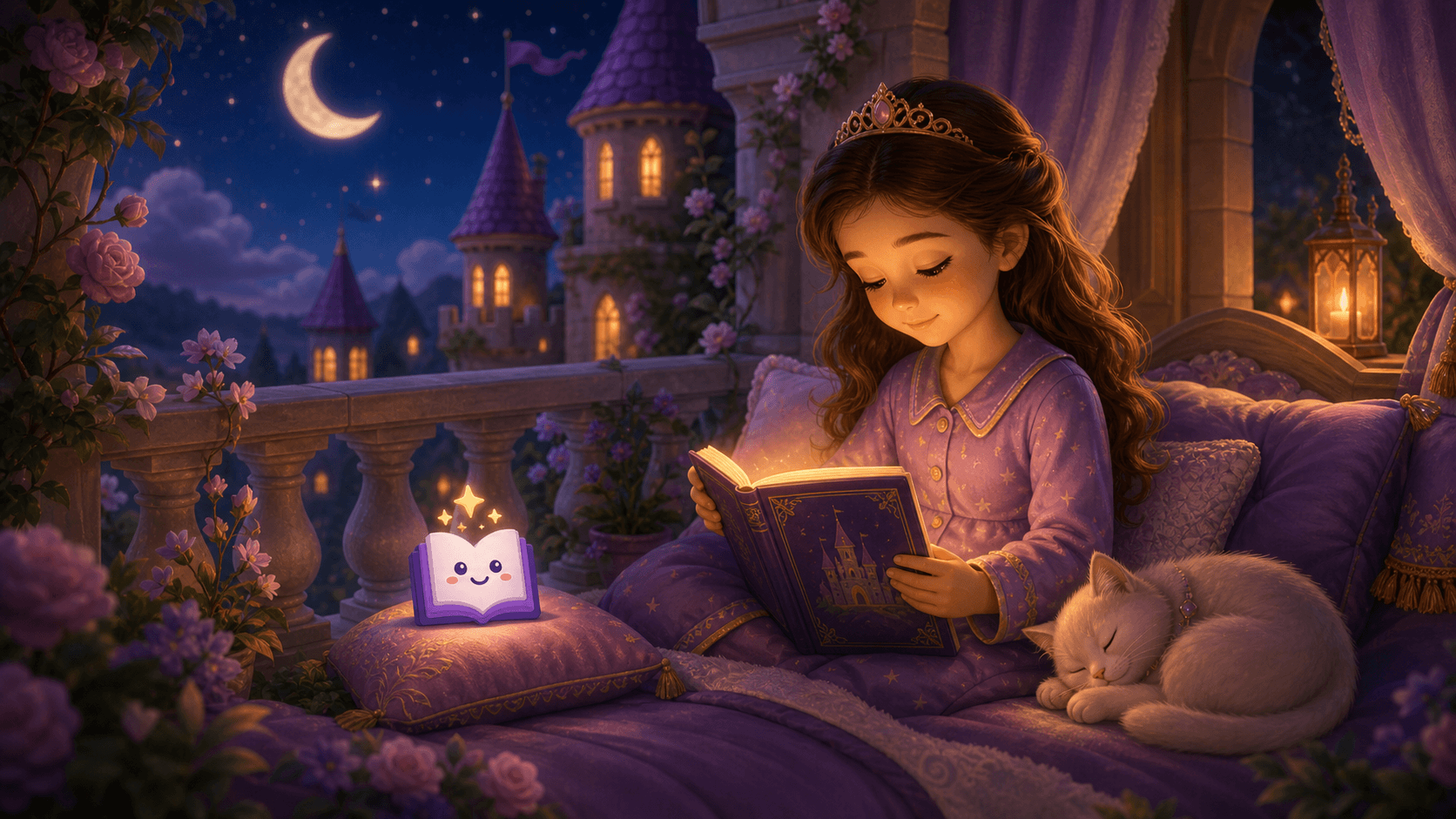
A princess bedtime story works best when it is 10–15 minutes long, features a kind and curious protagonist, involves a gentle challenge resolved before the end, and closes with the princess — and your child — settled and ready for sleep.
The princess story is one of the most enduring formats in children's bedtime storytelling for a reason: it combines adventure with safety, magic with warmth, and a clear moral arc that satisfies a child's developing sense of fairness. Done well, a princess bedtime story can be one of the most effective calming rituals available.
Below you will find a complete short princess bedtime story you can read tonight, followed by tips on adapting it by age and making it personal for your child.
In this article:
- The Princess Who Found the Moon — ready-to-read story (~10 min)
- Why Princess Stories Work at Bedtime
- Adapting by Age — toddlers through age 8
- Telling Without a Book
- Personalized Princess Stories
- Bedtime Routine Tips
- Choose Another Bedtime Story
The Princess Who Found the Moon
A short princess bedtime story — suitable for ages 3–7, reading time approximately 10 minutes.
Once upon a time, in a kingdom where the mountains touched the clouds, there lived a princess named Elara.
Elara had one very important job: every evening, she was the one who watched the moon rise over the mountains to make sure it found its way safely into the sky. She had done this every night for as long as she could remember.
But one evening, she looked up — and the sky was empty.
No moon.
Elara put on her soft travelling cloak and went out to find it.
She walked first to the old oak tree at the edge of the royal garden, where the fireflies lived.
"Have you seen the moon?" she asked.
"We saw it earlier," said the fireflies, blinking slowly. "It was tangled in the silver clouds above the lake."
Elara walked on, past the sleeping roses and the still fountain, until she reached the lake. The water was very quiet and very dark, and when she looked up, she could just see — yes — a soft glow, caught between two great clouds.
"Moon," she called gently. "Are you stuck?"
A long pause.
"A little," said the moon, in a voice like wind through curtains. "The clouds came from nowhere and I could not find the gap."
Elara thought for a moment. "What if I count to three and we both try?"
"All right," said the moon.
"One," said Elara.
The moon gathered itself.
"Two."
The clouds shifted slightly.
"Three."
With a soft, silver sigh, the moon slipped through — and rose, slowly and completely, into the clear sky above.
The lake lit up. The garden glowed. The mountains turned silver at their edges.
"Thank you," said the moon.
"Every night," said Elara.
She walked back through the garden, past the roses that had opened slightly in the moonlight, past the fireflies who were resting now, their lights dim and slow.
Inside the palace, the kingdom was quiet and asleep.
Elara climbed the stairs to her room, hung up her travelling cloak, and looked out her window at the moon — round and steady and exactly where it should be.
She got into bed.
"Goodnight," she said softly.
Far above, the moon shone on.
And in the palace, and in the kingdom, and in every house where children were falling asleep — everything was exactly as it should be.
Why Princess Stories Work at Bedtime
The American Academy of Pediatrics has recommended daily read-aloud time as a core part of healthy child development since 2014 — and princess stories fit naturally into this routine for children who are drawn to the theme.
The princess bedtime story format carries several elements that are naturally calming for children:
A clear quest with a gentle resolution. Elara has a problem — the moon is missing — and she solves it through kindness and collaboration, not conflict. Children's brains find this narrative arc deeply satisfying, and satisfaction at bedtime supports the transition to sleep.
Magic that is calm, not exciting. The moon, the fireflies, the silver light on the lake — these are magical elements that evoke wonder without raising arousal. The best calming bedtime stories use magic as atmosphere rather than action.
A character who goes to bed. Princess Elara ends the story in bed. This is not an accident — children often mirror the behaviour of story characters more readily than they respond to direct instruction. A story that ends with the protagonist settling for sleep gives the child a model to follow.
Adapting This Story by Age
| Child's age | Story length | Key focus |
|---|---|---|
| Toddler (2–3) | 5–8 min | Simplify to core arc, slow voice at end |
| Ages 4–6 | 10–15 min | Full story, add child's name and details |
| Ages 7–8 | 15–20 min | Expand story, add second challenge |
For toddlers (ages 2–3)
Simplify as you read. You can shorten the story to just the core arc — Elara, the missing moon, the count to three, the happy ending — in about 5 minutes. Use a slower, quieter voice as the story nears its end. Repetition works well: "The moon was very high. The sky was very clear. Everything was very, very still."
For children aged 4–6
Read the full story at a calm, unhurried pace. Children this age can hold the full narrative and will enjoy the detail of the fireflies and the lake. You can add small improvisations: ask what colour Elara's cloak is, what her bedroom looks like, whether she has a cat that sleeps on her bed.
For children aged 7–8
Older children can handle a longer version with more narrative weight. You might expand Elara's conversation with the moon, give the clouds a personality, or add a second small challenge along the way. Children this age also enjoy stories that feel more collaborative — you can ask them what Elara should do next before revealing the solution.
How to Tell a Princess Bedtime Story Without a Book
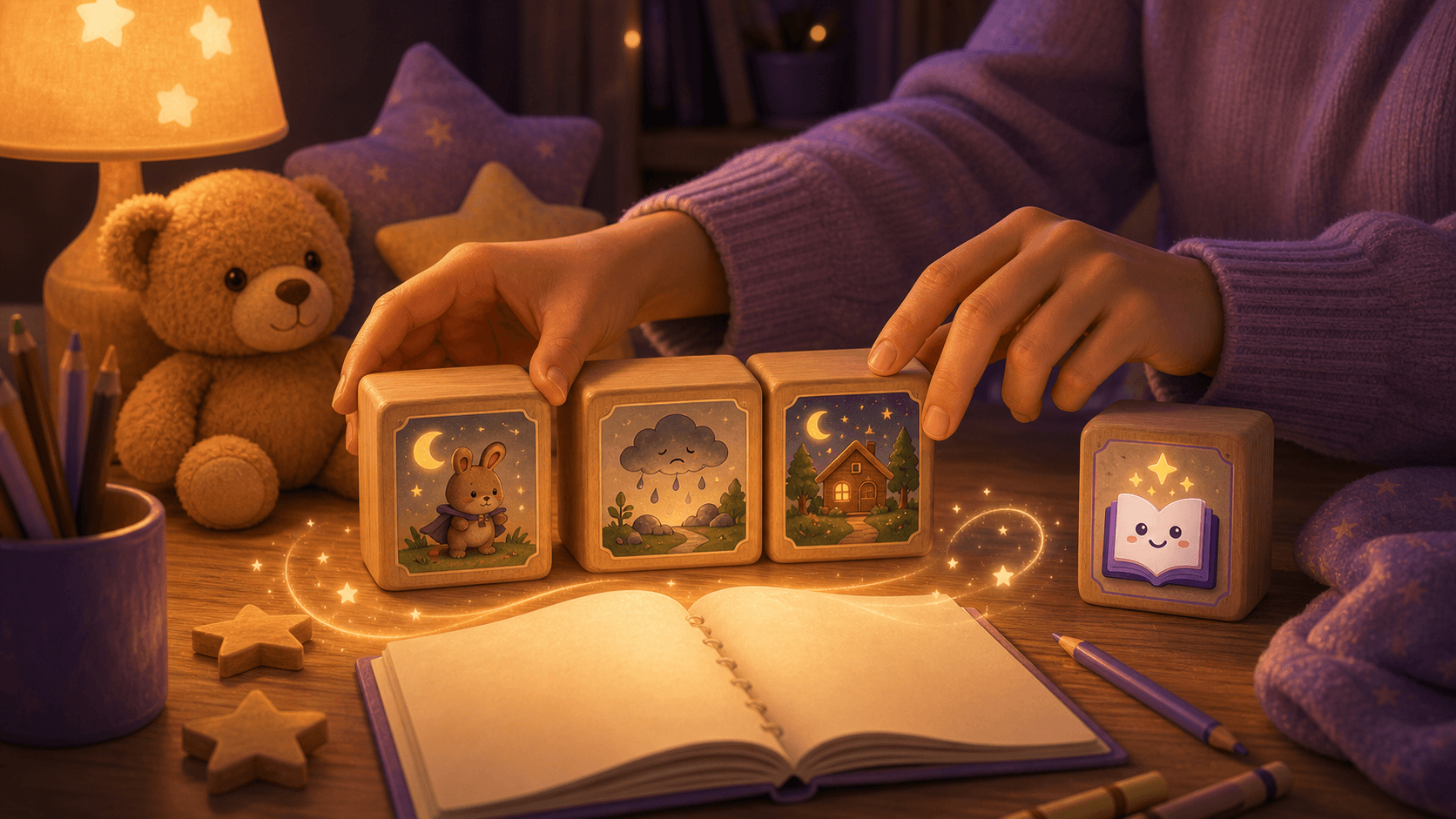
If you do not have a book to hand, you can tell a princess story entirely from memory using a simple structure:
- Who is she? Name the princess (ideally your child's name), give her one strong quality (brave, curious, kind, funny), and place her in a setting.
- What is wrong? Something small and gentle is out of place — a missing star, a lost bird, a friend who is sad.
- What does she do? She goes to look, she asks for help, she tries something clever.
- How does it end? The problem is gently solved. She returns home. She goes to sleep.
This four-part structure takes about 8 minutes when told slowly and works for any princess story regardless of specific plot.
Personalized Princess Bedtime Stories
The most effective princess bedtime story for your child is one that features them as the princess — their name, their qualities, their real world slightly transformed into something magical.
A personalized bedtime story built around a princess character works best when it includes:
- Your child's real name as the princess's name
- A challenge that mirrors something they are actually navigating — a new school year, a friendship worry, learning something difficult
- Supporting characters who are their real friends or family, in princess-world form
- An ending where the princess-character handles the challenge with kindness and comes to rest
At ages 4–6 especially, a child who hears their own name in a princess story will often sit completely still with a particular quality of attention — the story has become about them, and they know it.
Lulawe generates personalized bedtime stories where your child is the main character. You choose the theme — including princess stories — and the app builds a story around your child's name, age, and the details you provide. It takes about two minutes and gives you something specific and fresh to read tonight.
A Simple Princess Bedtime Routine for Better Sleep
Research on childhood sleep published in the journal Sleep (Mindell et al., 2015) found that children with a consistent nightly routine — including a story — fell asleep faster and slept over an hour longer per night than children without one. Consistency is the mechanism; the princess story is the cue.
A princess story lands best inside a predictable routine. A simple version that works:
- Warn 15 minutes before — "In 15 minutes we start the princess story."
- Get ready first — teeth, pyjamas, into bed before the story starts; the story is the reward for being ready, not the negotiation tool.
- One story — decided in advance. The princess story is the choice; how many is not the choice.
- Dim the light — reading in low light signals the body toward sleep.
- End at a calm moment — the story closes when the princess is settled; so does your child.
The bedtime routine matters as much as the story itself. Consistency over time is what trains the body to wind down on cue.
What to Read Next
If your child loves princess stories, they are likely ready for longer princess-themed chapter books. Some that work well at bedtime:
- The Princess in Black series by Shannon Hale — a princess who is secretly a superhero; funny, short chapters, genuinely exciting without being frightening
- The Paper Bag Princess by Robert Munsch — a princess who rescues a prince; warm subversive fun for children 4+
- Ella Enchanted by Gail Carson Levine — more complex; ideal for ages 7–8 who want a longer story
For a story where your child is the princess, try Lulawe. For more themed stories, see our unicorn bedtime story or dinosaur bedtime story. For full by-age recommendations, see the best bedtime stories for kids by age.
Choose Another Bedtime Story
Pick tomorrow night's gentle adventure:
- Dragon bedtime story
- Friendly monster bedtime story
- Superhero bedtime story
- Dinosaur bedtime story
- Space bedtime story
Or browse more bedtime story ideas for kids.