A train bedtime story works because the rhythm of a slow journey can feel like a lullaby. This complete story takes about 9 minutes and is written for children aged 3-7.
At a glance:
- Story: The Little Train That Carried Sleepy Thoughts
- Age: 3-7 years
- Reading time: about 9 minutes
- Mood: rhythmic, gentle, sleepy
- Theme: letting the day slow down
The Little Train That Carried Sleepy Thoughts
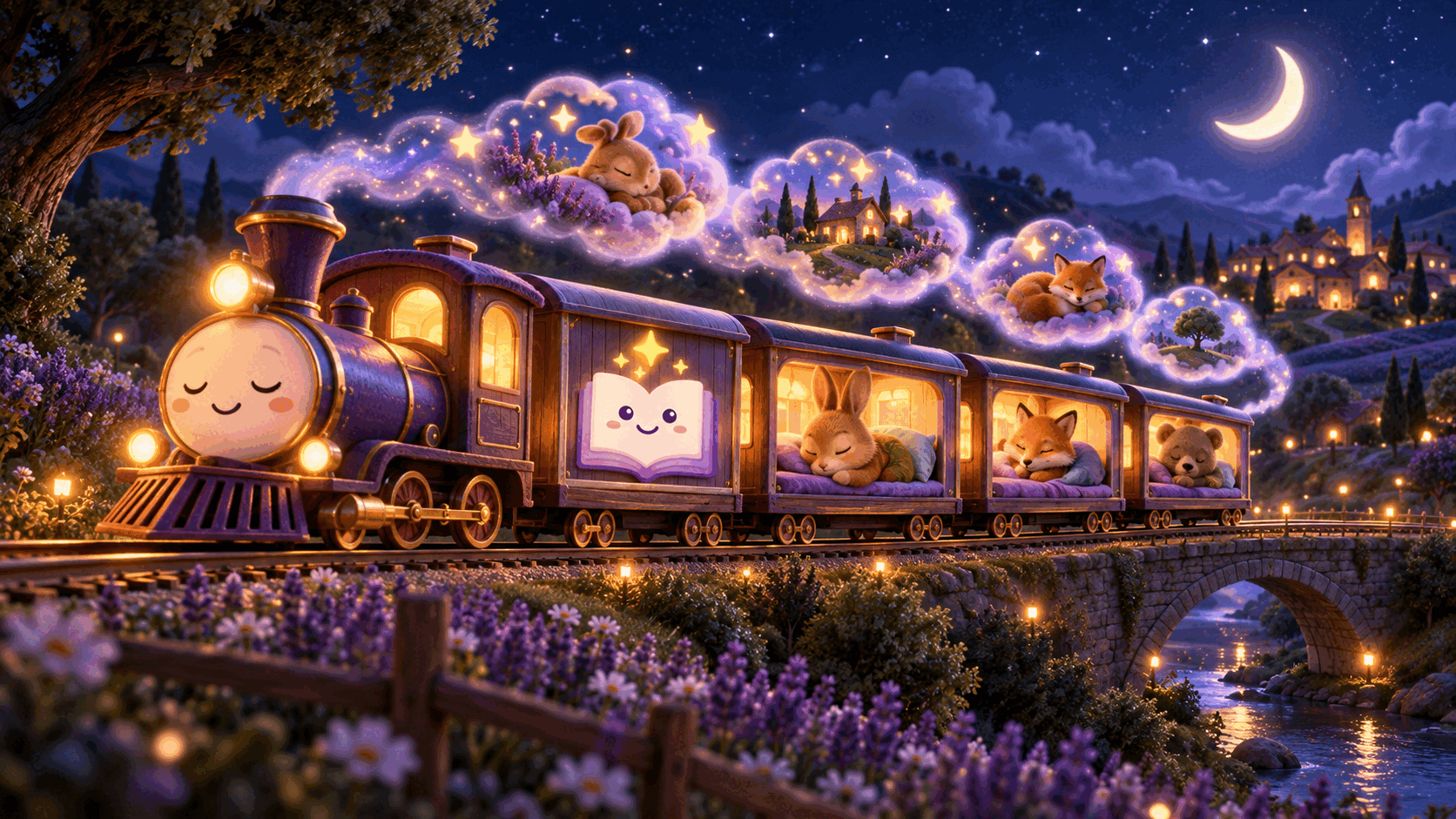
At the edge of Dream Valley stood a small blue train named Tilly.
Tilly was not the fastest train. She did not race through tunnels or blow her whistle loudly after sunset.
Tilly had a special job.
Every evening, she carried sleepy thoughts to their resting places.
"All aboard for bedtime," whispered the conductor.
Click-clack, click-clack, Tilly rolled from the station.
At the first stop, a child handed her a thought about a tower of blocks that had fallen down.
"This one can rest until morning," said Tilly.
She placed it in the soft Thinking Car, where it curled up beside a cushion.
Click-clack, click-clack.
At the second stop, a fox cub handed over a thought about tomorrow's rain.
"Tomorrow can carry tomorrow," said the conductor.
The fox cub yawned and waved.
Click-clack, click-clack.
At the third stop, a little owl brought a thought that would not stop asking questions.
"Where do clouds sleep? Why is the moon round? What if I forget my song?"
Tilly smiled with her headlamp.
"Questions may ride quietly too."
The question-thought climbed into the Thinking Car, tucked its question marks under a blanket, and became still.
The train climbed a moonlit hill. Below, the valley lights blinked softly, one by one.
The conductor walked through each car.
"Blocks can wait."
"Rain can wait."
"Questions can wait."
At the last stop was the Roundhouse of Rest. Tilly rolled inside slowly.
Her wheels stopped turning.
Her lamp dimmed.
The Thinking Car grew silent.
"Goodnight, tracks," whispered Tilly.
"Goodnight, hill."
"Goodnight, every thought that can wait until morning."
And in Dream Valley, the little blue train rested on her rails until the sun returned.
Why Train Stories Work at Bedtime
Train stories have natural repetition: stations, wheels, signals, and gentle movement. That makes them easy for children to follow when they are tired.
This story turns busy thoughts into passengers. It does not tell children to stop thinking; it gives each thought a place to rest. That can be useful for children who become chatty or worried at bedtime.
If your child needs more help slowing down, pair this story with a screen-free bedtime routine.
Adapt the Story by Age
| Child's age | Best version | Bedtime focus |
|---|---|---|
| 3-4 | Use two stops only | Rhythm and repetition |
| 5-6 | Read all three stops | Naming thoughts gently |
| 7 | Let the child choose one passenger thought | Emotional closure |
Make Up Your Own Train Story
Choose three quiet stations, one gentle problem at each, and a final roundhouse. Repeat the same sound between stops so the story becomes predictable.
Good station ideas include Blanket Bridge, Moon Meadow, Pillow Platform, and Yawn Yard.
Personalize Tonight's Story
Change the train's color, route, conductor, and passenger thoughts. Your child can become the conductor who helps the day settle.
For a custom sleepy train story, create one with Lulawe. You can also try a robot bedtime story or construction bedtime story for another calm machinery theme.