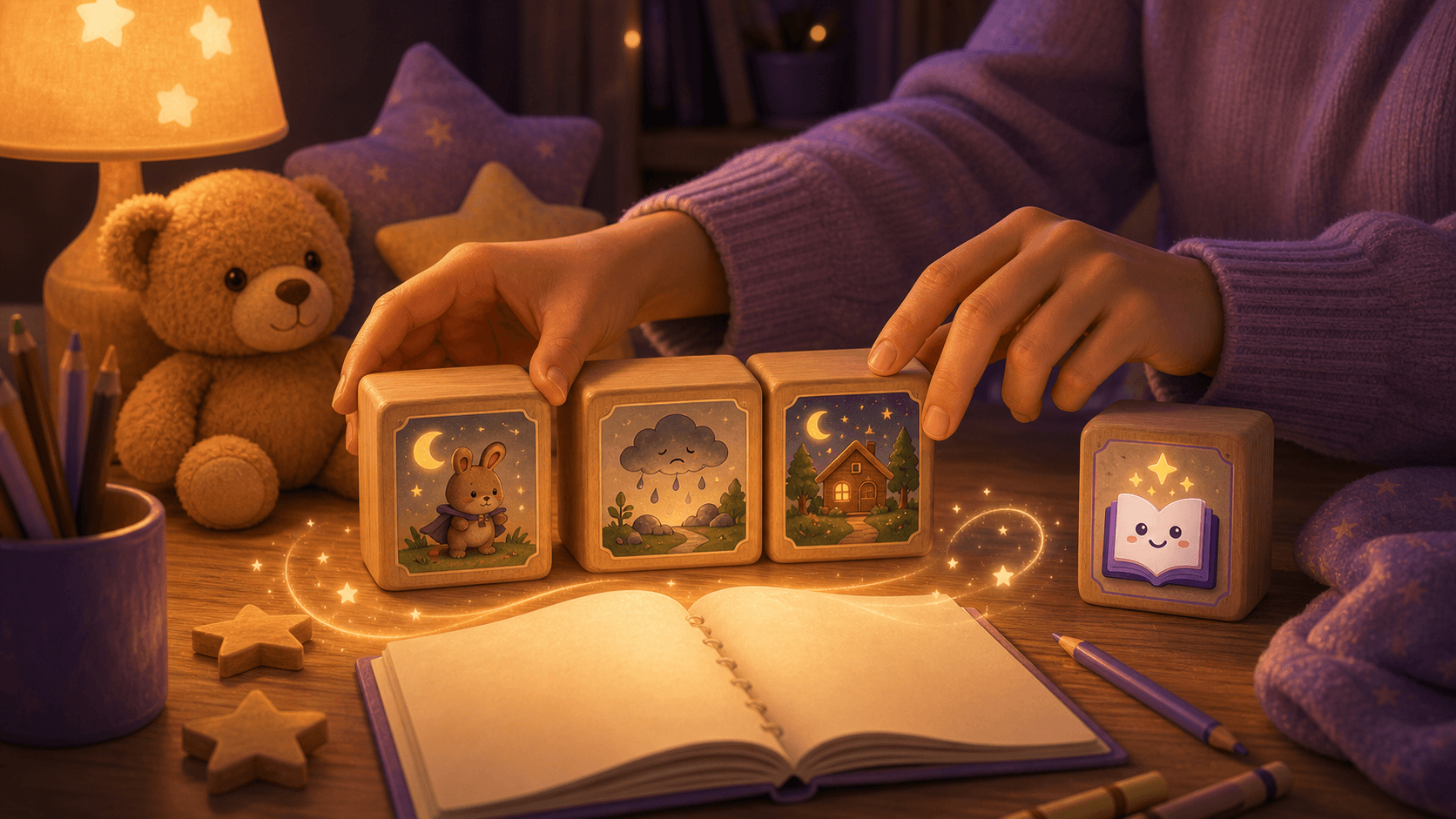
The best bedtime story for an 8-year-old runs 25–35 minutes, features moral complexity, and leaves your child with something to think about — but not so much that it keeps them awake. Eight is the age when stories stop being entertainment and start being a way of working out who you are.
What makes a good bedtime story for an 8-year-old: A story of 25–35 minutes with a protagonist facing genuine moral complexity, strong narrative voice, and enough resolution at the end of each session to allow sleep. Chapter books are the default at this age; the best ones feel like an ongoing conversation.
Eight-year-olds are at a pivotal developmental moment. They are increasingly peer-oriented, building a clear sense of personal identity, wrestling with questions of fairness and belonging in ways that feel genuinely high-stakes. They have also developed enough cognitive sophistication to appreciate narrative structure, authorial voice, and the kind of moral ambiguity that younger children find confusing.
The bedtime story at this age, done well, is one of the most effective parenting tools available — a nightly space where complex feelings can be explored through the safety of fiction, before the brain is asked to power down for sleep.
The 8-Year-Old at Bedtime: Developmental Context
At 8, children:
- have a vocabulary of 6,000–10,000 words and process complex narrative with ease
- understand irony, unreliable narrators, subtext, and foreshadowing — and enjoy noticing them
- care intensely about identity questions: who am I, what do I value, how do others see me
- are increasingly peer-oriented; friendships are more complex, more layered, and more central
- can follow a chapter book across many sessions, holding character arcs and plot threads in memory
- have genuine genre preferences — some want fantasy, others prefer realistic fiction or adventure
- may experience bedtime anxiety tied to school performance, social dynamics, or the increasing complexity of their interior life
- are beginning to develop opinions about writing — they notice when a story is poorly constructed
The bedtime story for an 8-year-old is often where they process the identity questions they have been carrying through the day. A story about a character who does not fit neatly into the world but finds their place anyway — that is not just entertainment. It is exactly what an 8-year-old needs at lights-out.
What Makes a Great Bedtime Story for an 8-Year-Old?
Moral complexity
Eight-year-olds are done with stories where the right choice is obvious. They want characters who face genuine dilemmas — where loyalty conflicts with honesty, or courage conflicts with kindness, or self-interest tempts a character who is otherwise good. Stories that acknowledge the difficulty of doing the right thing resonate far more deeply at this age than stories where goodness is easy.
Strong narrative voice
Eight-year-olds have developed enough literary awareness to appreciate distinctive authorial voice. Roald Dahl's conspiratorial warmth, C.S. Lewis's grandeur, Norton Juster's wordplay — children this age feel and respond to these qualities even if they cannot name them. A distinctive voice also makes longer books feel more like a relationship than a task.
Genuine stakes
Something must truly matter. Friends, identity, justice, belonging — the stakes do not need to be world-ending, but they need to feel real. An 8-year-old will disengage from a story where nothing is truly at risk.
Resolution within each session
Even a complex, long-running story needs to end each nightly session at a point of relative calm. Chapter books that build to cliffhangers are exciting — but ending on unresolved tension raises arousal, which is the opposite of what you need at bedtime. Stop at a quieter moment; the anticipation of tomorrow is enough.
The right length
25–35 minutes is the target for most 8-year-olds. That is typically one to two chapters. If your child is tired, one chapter is right. If they are alert and settled, two shorter ones can work well.
How Bedtime Stories Change at 8 (Compared to 7)
| What changes | At 7 | At 8 |
|---|---|---|
| Story length | 20–30 minutes | 25–35 minutes |
| Moral complexity | Fairness, simple right/wrong | Genuine dilemmas, grey areas |
| Identity themes | Belonging, social dynamics | Who am I, what do I value |
| Narrative awareness | Follows structure well | Notices and critiques structure |
| Genre preferences | Broad | More specific — has real preferences |
| Emotional depth | Strong character empathy | Internalises character experience |
The key shift at 8 is inward. If you have been reading with your child through the 7-year-old stage, the shift is noticeable — seven-year-olds engage with stories through character and plot, while eight-year-olds engage through identification, asking what this story says about them.
Chapter Books for 8-Year-Olds at Bedtime
Best chapter books for 8-year-olds:
- Harry Potter and the Philosopher's Stone by J.K. Rowling — identity, belonging, the discovery of a hidden self; near-perfect for 8-year-olds
- The Phantom Tollbooth by Norton Juster — wordplay, logic, ideas as adventure; brilliant for curious 8-year-olds
- Danny the Champion of the World by Roald Dahl — loyalty, justice, the parent-child bond; warm and morally rich
- Matilda by Roald Dahl — intelligence as power, institutional injustice overcome; particularly good for children who feel underestimated
- The Treehouse series by Andy Griffiths — absurdist, funny, episodic; ideal for reluctant readers or children who need lighter bedtime content
- The Lion, the Witch and the Wardrobe by C.S. Lewis — epic scope, sacrifice, redemption; morally complex in a way 8-year-olds can hold
- A Wrinkle in Time by Madeleine L'Engle — identity, courage, love as a force; intellectually challenging in the best way
- The Invention of Hugo Cabret by Brian Selznick — half graphic novel, half prose; extraordinary visual storytelling, accessible and beautiful
- My Side of the Mountain by Jean Craighead George — independence, nature, self-reliance; appeals strongly to children who feel constrained
Choosing tip: Ask your child what they want the next book to feel like — adventurous, funny, magical, realistic — and use that as your filter. Eight-year-olds with ownership over the book choice invest more in the story.
Short Bedtime Story for an 8-Year-Old: The Glass Bridge
Here is a ready-to-read short bedtime story for an 8-year-old you can use tonight.
There was a bridge made entirely of glass, and everyone in the kingdom was afraid to cross it.
Not because it might break — the glassmakers had sworn it would hold a hundred elephants. But because when you walked across it, everyone on both sides could see you perfectly. Every stumble, every expression, every doubt.
Most people went the long way around.
Iris had to cross it.
Her grandmother lived on the other side, and the long way would take three days, and her grandmother was sick.
She stood at the edge of the bridge for a long time, watching the people who watched her watching it.
Then she stepped on.
The glass was cold under her feet. She could feel people's eyes from both sides, and she did not look graceful, and she stumbled twice, and her face did things she would have preferred it not to do.
But she kept walking.
Halfway across, a boy on the far bank called out, "You're almost there."
She looked up. He was smiling — not laughing, just... encouraging.
She made it.
On the other side, the boy was waiting. "First time?" he asked.
"Is it that obvious?"
"Everyone looks like that the first time," he said. "Like they're waiting to be judged."
"Aren't they?"
He thought about it. "I think most people are too busy worrying about their own crossing to really look at yours."
Iris looked back at the bridge. A woman was halfway across now, also stumbling, also making faces.
Iris waved. The woman looked surprised. Then she waved back.
They walked on.
Bedtime Stories for 8-Year-Olds with Anxiety
Eight-year-olds with bedtime anxiety often have more sophisticated worries than younger children — social performance, academic pressure, fears about the future, identity concerns. Generic reassurance rarely helps at this age because 8-year-olds are perceptive enough to know when they are being managed.
Stories work better than reassurance for two reasons: they approach the anxiety obliquely, through a character rather than directly at the child; and they model navigation rather than avoidance — the character feels the anxiety and acts anyway.
What to look for:
- A protagonist who explicitly experiences something like your child's worry
- A resolution that is earned through effort and realistic support
- A tone that takes the anxiety seriously rather than minimising it
A personalized bedtime story tailored to your child's specific concern — a school presentation, a friendship conflict, a fear of failure — can be especially effective at 8, because the age-appropriate specificity makes the story feel genuinely seen rather than generic. For ready-to-use examples, see our calming bedtime stories for anxious children.
Personalized Bedtime Stories for 8-Year-Olds
Eight-year-olds are at the peak age for personalized storytelling in one specific way: they are old enough to engage with a story as a genuine mirror of their life, and young enough to still find that magical rather than self-conscious.
A personalized bedtime story for an 8-year-old works best when it:
- features the child's real name and several specific true details — their school, their best friend, their hobby
- builds around a challenge they are actually facing — not a fantasy version, but something real
- shows the child-character navigating it with courage, kindness, and realistic imperfection
- ends peacefully, with the character in a settled place
At 8, a story that does this well is not just entertainment. It is a private acknowledgement that their inner world is seen and taken seriously — which is exactly what children this age most need, and rarely ask for directly.
Tools like Lulawe let you build personalized bedtime stories around your child's name, interests, and themes — generating something specific and fresh each night without having to invent a whole story from scratch.
Bedtime Routine for an 8-Year-Old
Eight-year-olds often push back more on bedtime than younger children — not because they need less sleep, but because they are more aware of what they are missing and more capable of arguing about it. A fixed, predictable routine reduces this significantly.
- Start winding down 30–45 minutes before lights-out — screens off, low lighting, quiet activity
- Physical routine — wash, brush, change; the body learns this sequence predicts sleep
- One or two chapters — agreed before reading starts; the number is not a negotiation
- Brief check-in — three minutes for anything on their mind; this prevents the "one more thing" delay pattern
- Lights out at a consistent time — the American Academy of Sleep Medicine recommends 9–12 hours for school-age children; protect this
The story is most effective as a sleep association when it is the last thing before lights-out, in the same place, at the same time. Consistency is the mechanism — not any individual story.
Common Mistakes at 8
Choosing stories below their level
Eight-year-olds who are bored will drag out bedtime in other ways. If your child seems disengaged, the story is probably too easy. Move up.
Letting the story become a bargaining chip
"One more chapter" is a common tactic at this age. Set the expectation clearly before reading: one chapter, then sleep. Do not negotiate mid-story.
Stopping on a cliffhanger every night
It feels exciting, but it raises arousal and makes settling harder. If you can, end two pages past the cliffhanger, at a calmer beat.
Skipping the check-in
Eight-year-olds who have something on their mind will find ways to delay sleep. A brief, genuine check-in before lights-out — "anything you want to talk about?" — often prevents 20 minutes of stalling.
What About Audiobooks at 8?
Eight-year-olds — particularly keen readers who also read independently — often love audiobooks. A well-narrated audiobook of a chapter book they are following is an excellent bedtime option, and the narrator's voice can provide the same calming cue as a parent reading aloud, once the association is established.
Good sources: Audible's children's catalogue, Epic!, and Libro.fm for independent bookshop support. The same rule applies: end at a calm moment, not a cliffhanger, and keep it consistent in the routine.
Final Thoughts
The best bedtime story for an 8-year-old takes them seriously — complex enough to match their developing mind, warm enough to settle their often-busy heart, and consistent enough to become a signal their body trusts.
Eight is also, in many families, one of the last ages when a child will reliably choose a bedtime story with you over other options. The chapter book you start this week might be one they remember for years.
Start it tonight.