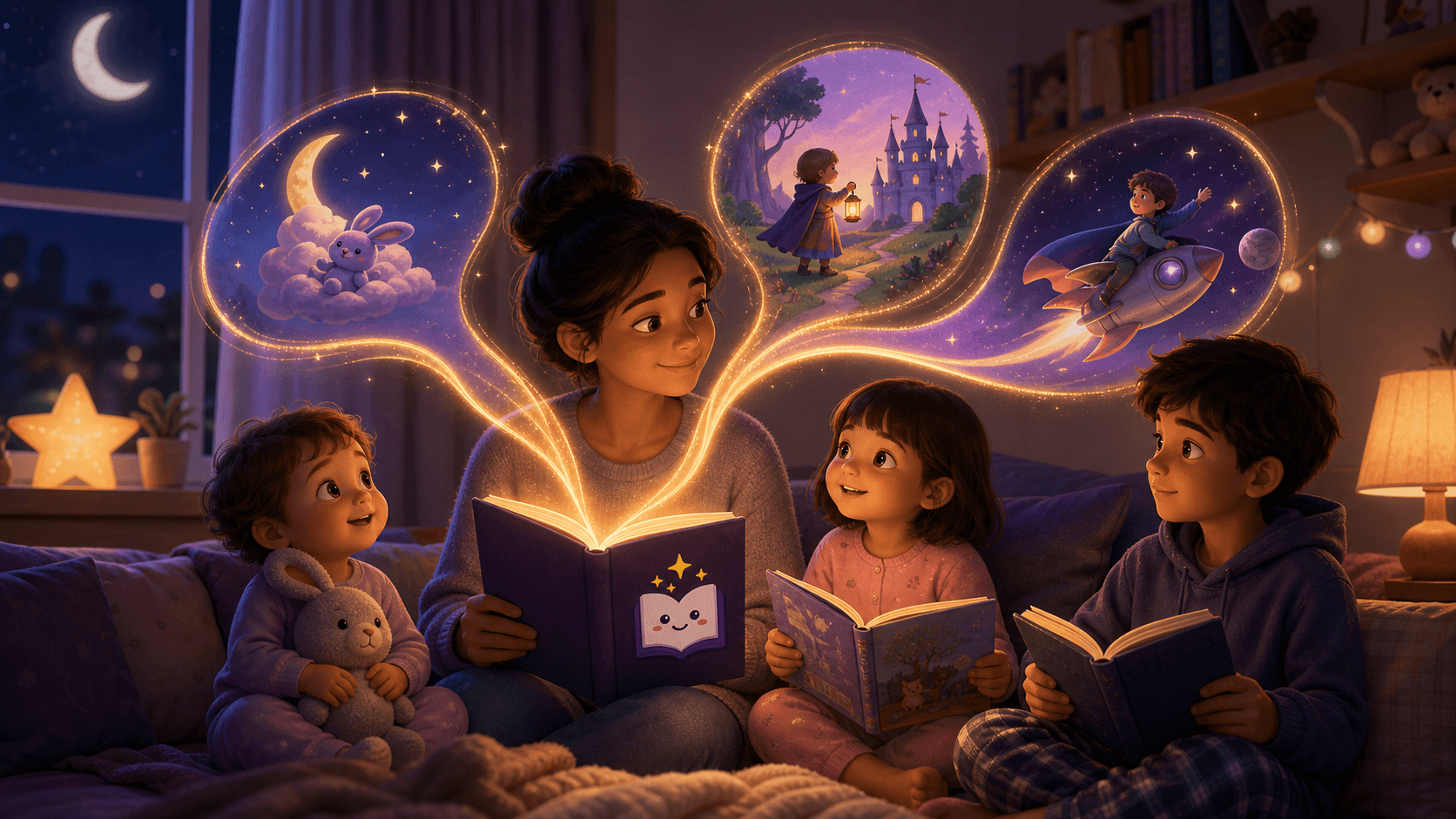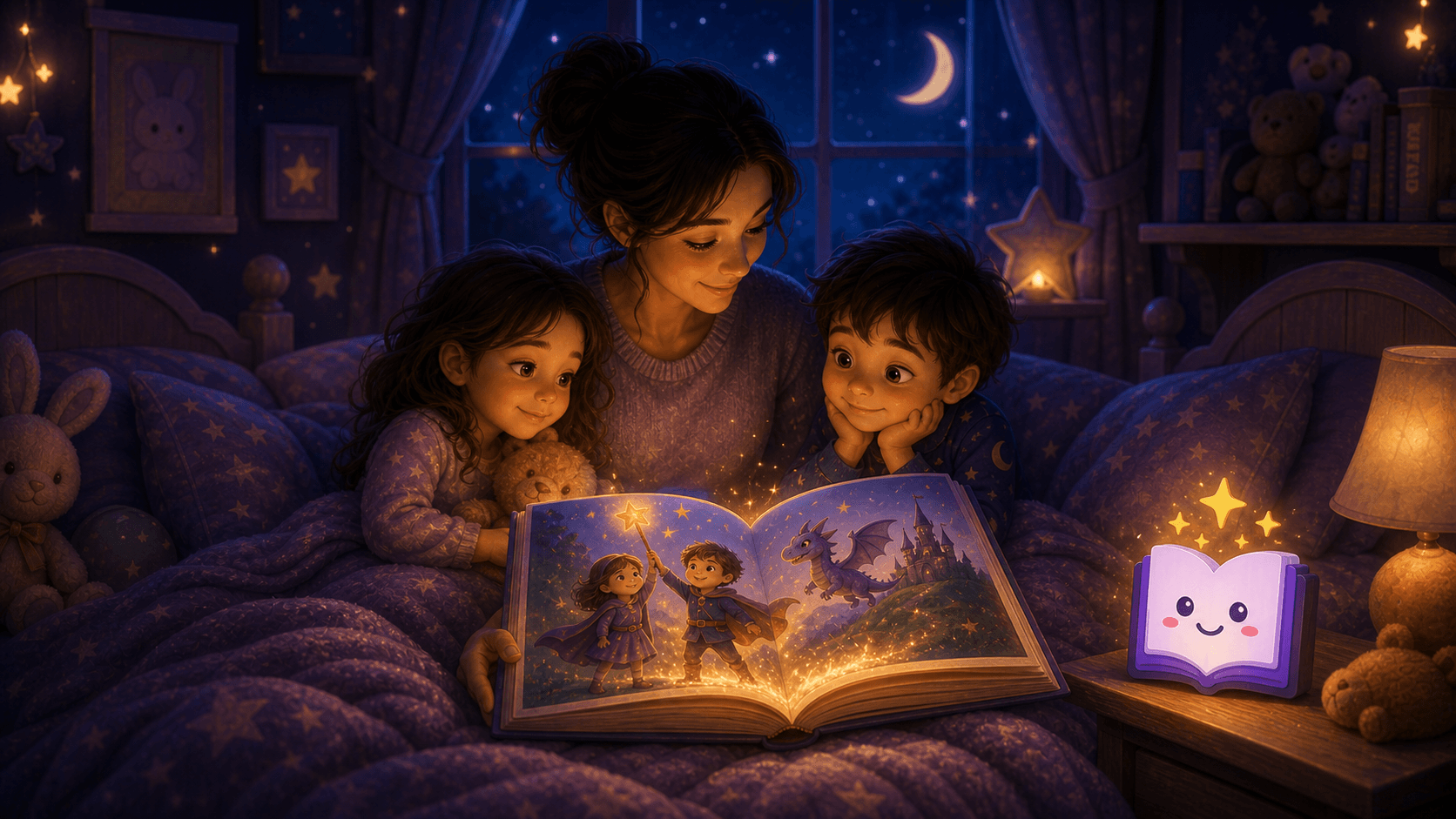
Personalized bedtime stories for siblings are stories in which two or more children share the adventure and each child has a meaningful role. The simplest version uses both names, one interest from each child, a small problem they can solve together, and a calm ending that brings everyone home or into bed.
The key is not giving every child exactly the same number of lines. It is giving every child a reason to matter.
That distinction turns a generic family story into a genuine personalized bedtime story. One sibling might spot the moon bridge. The other might know how to wake it. Both are needed before the characters can cross and return home.
Quick Takeaways
- Give each sibling a distinct strength, choice, or action.
- Combine one interest from each child instead of choosing a single winner.
- Match the language to the younger listener and the role complexity to each age.
- Use cooperation, not competition, as the story engine.
- Rotate who starts the adventure from night to night.
- Keep real arguments out of the plot while emotions are still raw.
Why Ordinary Bedtime Stories Can Be Hard With Two Children
Shared story time sounds simple until two children want different things.
One wants dinosaurs. The other wants mermaids. One is ready for a longer plot. The other loses the thread after three minutes. Both want to choose the book, sit closest, turn the page, and be the hero.
The problem is not that siblings are bad at sharing. A single story is being asked to fit different ages, interests, and attention spans at the same time.
Research on simultaneous book sharing with preschool siblings shows why age matters. In an exploratory study of five families, mothers adjusted book complexity and their reading support differently for older and younger children. Shared reading did not erase developmental differences; parents still had to mediate for both listeners (American Speech-Language-Hearing Association).
Personalization helps because the story can be designed around those differences from the start.
The broader case for shared reading is better established than any sibling-specific benefit. A 2026 Japanese cohort study of 36,866 mother-child pairs found that more frequent shared storybook reading was associated with higher developmental scores, while its authors explicitly cautioned that the observational data could not establish causation (Pediatric Research).
What Makes a Good Sibling Story?
A good sibling bedtime story gives each child four things:
| Story element | What it answers | Example |
|---|---|---|
| Recognition | "Am I in this story?" | Name, nickname, pet, or familiar detail |
| Agency | "Do my choices matter?" | One decision or useful action |
| Fairness | "Does my sibling matter too?" | A different but equally necessary role |
| Safety | "Does this end well?" | Home, comfort, reunion, or sleep |
The siblings do not need identical roles. In fact, identical roles can make a story flatter.
Try complementary roles instead:
- one child notices, the other remembers
- one child asks, the other experiments
- one child comforts, the other guides
- one child chooses the path, the other chooses what to bring
- one child understands animals, the other understands maps
The result feels fair because both contributions change what happens.
Use the Two-Hero Story Formula
Use this reusable five-part structure:
[Sibling 1] and [Sibling 2] enter [safe setting]. Each brings [one personal strength or interest]. They face [one gentle problem], solve it through [cooperation], and end [home, cozy, or ready for sleep].
Here is a complete example:
"Mila loved sea creatures, and Ben knew every kind of train. One evening, they found a tiny moon whale waiting beside a silver railway. Mila understood where the whale needed to go, while Ben worked out which quiet train could carry it. Together they returned the whale to its cloud ocean, rode home under the stars, and tucked the last ticket beneath their pillow."
This works because neither child is decoration. Remove either sibling and the solution no longer works.
For more building blocks, use these bedtime story prompts for kids or the simple process in how to make your child the hero of a story.
How to Combine Different Interests
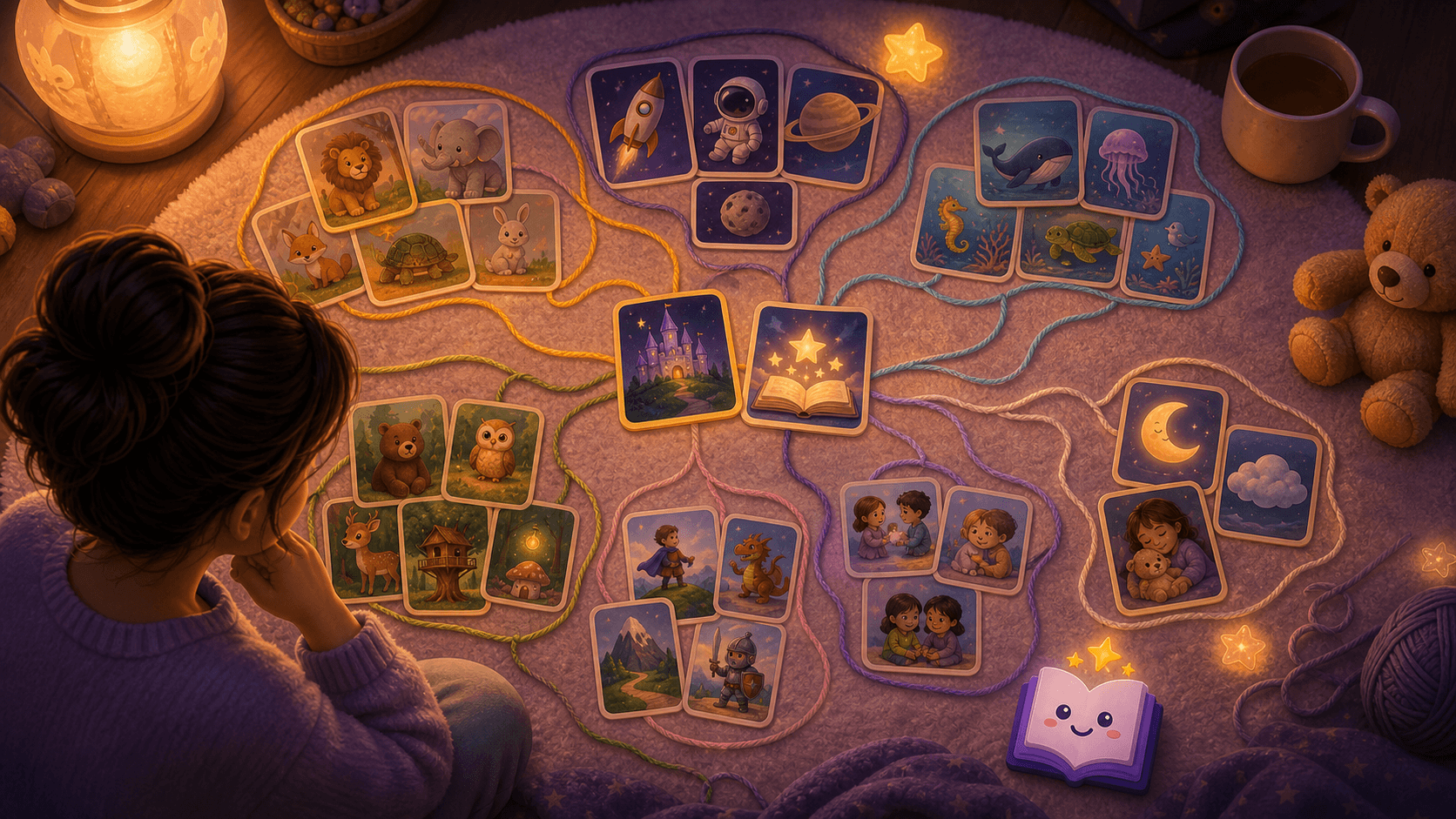
Do not make the children negotiate one theme before the story begins. Combine their interests into one small world.
| Child 1 likes | Child 2 likes | Shared story idea |
|---|---|---|
| Dinosaurs | Baking | Two siblings help a shy dinosaur bake a moon-shaped loaf |
| Space | Cats | A space cat needs two copilots to park a sleepy comet |
| Fairies | Trains | A tiny fairy railway delivers blankets to the forest |
| Ocean animals | Superheroes | Two gentle heroes return a lost turtle to its reef |
| Trucks | Rainbows | A quiet crane rebuilds a rainbow bridge before bedtime |
Use one recognizable detail from each child, not every current obsession. Too many details create noise and make the plot harder for younger listeners to follow.
A 2025 systematic review of caregivers' shared-reading experiences similarly found that parents valued books whose language, structure, and complexity matched a child's developmental stage. That evidence concerns parent-child reading generally, not personalized sibling stories, but it supports designing one shared story around both children's actual comprehension needs (Frontiers in Psychology).
Personalize for Different Ages
When siblings have an age gap, aim the sentence length and plot at the younger child. Then give the older child more responsibility inside that simple plot.
| Age combination | Story design |
|---|---|
| Toddler + preschooler | Repetition for the toddler; one simple choice for the preschooler |
| Preschooler + early reader | Short plot; let the older child predict or supply a repeated line |
| Early reader + older child | Shared premise; give the older child a puzzle or planning role |
| Twins or same-age siblings | Different strengths and alternating first choices |
An age-appropriate story is not only about vocabulary. It also considers plot length, emotional intensity, and how much information a child must hold in mind.
For a wider age breakdown, see personalized bedtime stories by age.
Make Participation Fair Without Counting Lines
Parents can get trapped trying to make every detail perfectly equal. That often creates a stiff story and invites children to audit it.
Balance the story across several nights instead:
- Tonight, one sibling discovers the problem.
- The other sibling makes the final helpful choice.
- Tomorrow, reverse who begins the adventure.
- Keep a shared ending ritual for both children.
You can also rotate one small privilege:
- who chooses the setting
- who names the side character
- who selects the gentle story goal
- who supplies the repeated phrase
- who decides how everyone gets home
Research on contextual questions during parent-child co-reading found more conversational turns and deeper everyday-life connections in a study of 12 parent-child pairs. That study was not about siblings, so it does not prove a sibling-specific effect. It does support a useful practice: one well-timed question can create participation without turning reading into a quiz (ContextQ study).
With siblings, ask one question each and continue the story.
Story Ideas for Common Sibling Moments
When one child always wants to lead
Give the confident child a role that requires listening. Give the quieter child information only they can understand.
Example: the older sibling can steer the boat, but the younger sibling is the only one who can hear the moonfish directions.
When siblings have argued
Do not replay the argument with thinly disguised characters. Children usually recognize the lesson immediately, and bedtime can start feeling like a second correction.
Use emotional distance. Two cloud keepers can repair a torn blanket by contributing different patches. The story can model cooperation without deciding who was right earlier.
When a new baby arrives
Keep the older child central rather than making the entire story about helping the baby. The older sibling can have their own goal while the baby contributes a tiny sound, smile, or clue.
When siblings sleep in different rooms
Give them a shared opening and separate cozy endings. The characters might complete one mission, then return to two different nests, cabins, or star beds.
When only one child wants a story
Avoid forcing joint participation. Let the interested child choose the story while the other listens, draws quietly, or joins only for the ending. Shared story time works best when inclusion is available rather than compulsory.
A 60-Second Prompt for a Two-Child Story
Copy this prompt and replace the brackets:
Create a calm personalized bedtime story for [child 1 name and age] and [child 2 name and age]. Include [interest 1] and [interest 2]. Give each child a distinct, equally meaningful role in solving one gentle problem. Do not make either child the villain, helpless sidekick, or permanent rescuer. Use age-appropriate language for the younger child, keep the story to about [5] minutes, and end with both children safe, cozy, and ready for sleep.
Review the result before reading. Check that:
- both names are correct
- both children affect the outcome
- the age gap is handled naturally
- no child is blamed or embarrassed
- the ending lowers energy
- private details are not unnecessarily included
A child profile can save age and interest preferences so parents do not have to rebuild the prompt each night.
Where Lulawe Fits
Lulawe supports multiple story profiles, so siblings can each have their own age and interests. Parents can also create stories featuring two children together.
The practical flow is:
- Create one profile for each child.
- Choose a calm story style and shared theme.
- Give each child one meaningful story detail.
- Generate the story and review it before reading.
- Save successful stories for nights when familiarity matters more than novelty.
The Getting Started with Lulawe guide explains the profile and story-creation flow. If sibling co-hero stories fit your family, join the Lulawe waitlist to create personalized stories without starting from a blank page.
What Sibling Stories Cannot Do
A shared story can offer a warm cooperative moment. It cannot guarantee that siblings will become closer, stop competing, or resolve a persistent conflict.
It also should not replace individual attention. Some nights work best as a joint story. Other nights, each child needs a separate book, a private conversation, or a few minutes alone with a parent.
Use personalized sibling stories as one option in the family routine, not as a fairness test or behavior treatment.
The Best Sibling Story Gives Both Children a Place
The strongest personalized bedtime stories for siblings do not make two children compete for one hero role.
They create a story that needs both of them.
Start with two names, two interests, one gentle problem, and one shared return to safety. Let each child contribute something the other cannot. Then rotate the spotlight tomorrow.
That is enough to turn bedtime from "Whose story is it?" into "What will we do together tonight?"